
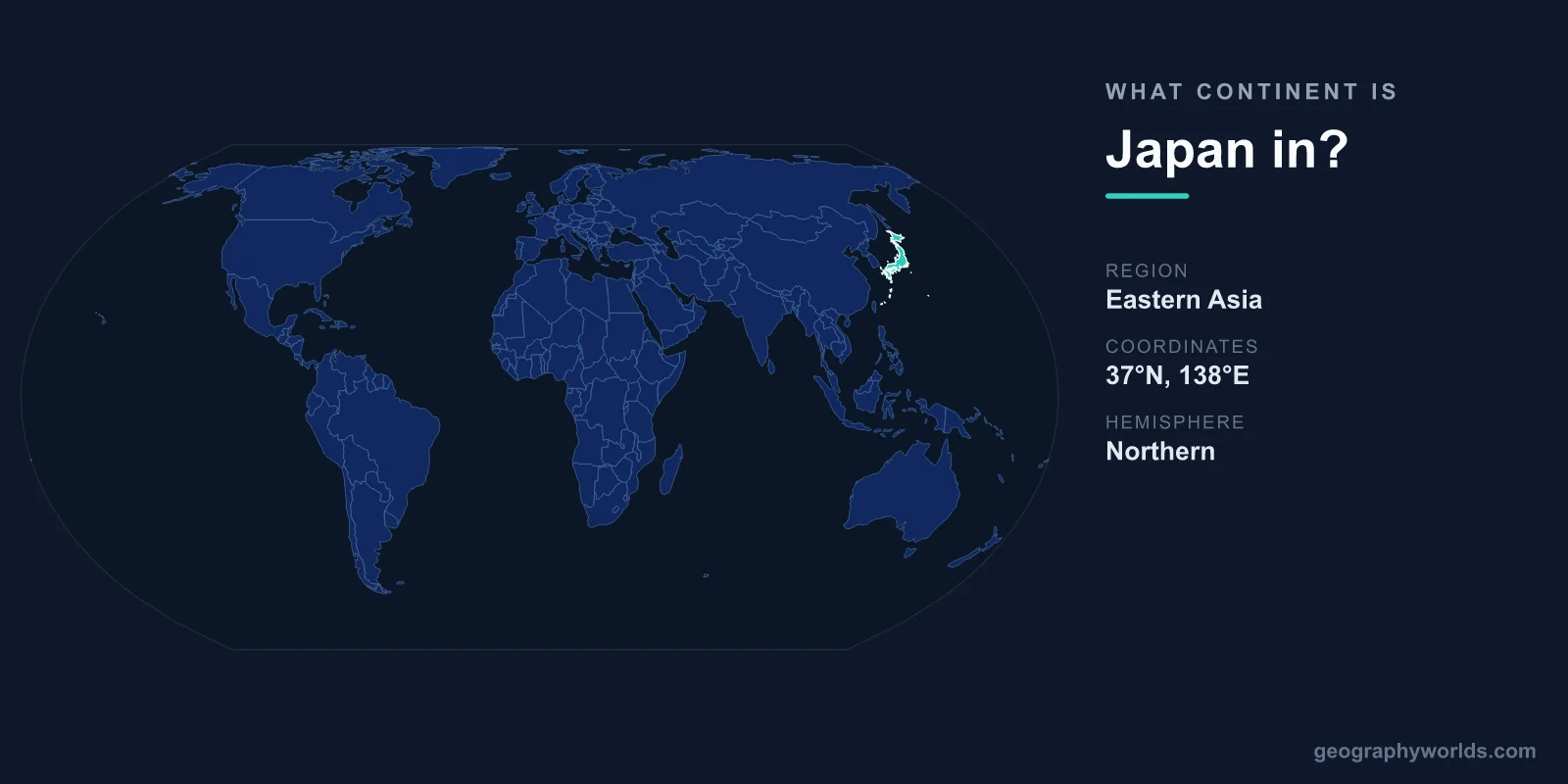
Japan is in Asia — specifically the region of East Asia. It is an island nation in the western Pacific Ocean, lying off the eastern edge of the Asian mainland. Although Japan shares no land border with any other country, it is firmly counted as part of the Asian continent, both geographically and culturally.
Why Japan Belongs to Asia
Continents are defined by the large landmasses they sit on and the tectonic and cultural ties that bind nearby territories together. Japan sits just east of mainland Asia, separated from China, the Korean Peninsula, and Russia by the Sea of Japan (also called the East Sea). At its narrowest, the Korean Strait places Japan only about 200 km from South Korea, close enough that the two have traded people, language, and ideas for thousands of years.
Being an island country does not remove a nation from a continent. Just as the British Isles are part of Europe and Indonesia is part of Asia, Japan's offshore position does not change its membership. The country lies on the same continental shelf system as East Asia and shares deep historical connections with China and Korea in writing, religion, cuisine, and governance.
Japan's Place on the Map
Japan stretches in a long arc from the subarctic north to the subtropical south. To the west lie the Korean Peninsula and China; to the north sits Russia's Sakhalin Island; and to the south lie Taiwan and the open Pacific. Key location facts include:
- Continent: Asia
- Region: East Asia
- Capital: Tokyo
- Total area: 377,975 km²
- Land borders: None (an island nation)
Despite its modest land area, Japan is the 11th most populous country on Earth and has long held one of the world's largest economies. Its capital, Tokyo, anchors the most populous metropolitan area in the world, home to more than 37 million people.
An Archipelago of Thousands of Islands
Japan is made up of roughly 6,852 islands, though four main islands account for about 97% of the total land area. These are:
- Honshu — the largest island, home to Tokyo, Osaka, and Kyoto
- Hokkaido — the cool, mountainous north, known for snow and skiing
- Kyushu — the southwestern island, the closest to mainland Asia
- Shikoku — the smallest of the four main islands
Because the archipelago runs from north to south across many degrees of latitude, Japan's climate ranges dramatically. Hokkaido sees heavy winter snowfall, while the Okinawa islands far to the south enjoy a subtropical climate with coral reefs and warm seas year-round. This north-to-south spread gives Japan an exceptionally long coastline of nearly 29,751 km.
Sitting on the Pacific Ring of Fire
Japan's location is shaped by powerful geological forces. The country sits on the Pacific Ring of Fire at the junction of four tectonic plates, making it one of the most seismically active places on the planet. Japan experiences around 1,500 earthquakes each year, though the vast majority are too small to feel.
This same activity gives Japan more than 100 active volcanoes. The most famous is Mount Fuji, the country's highest peak at 3,776 metres and a symbol recognised worldwide. Fuji is an active stratovolcano whose last eruption was in 1707. The volcanic landscape also feeds Japan's thousands of natural hot springs, or onsen, a cherished part of daily life and travel.
Connected to Asia in Culture and History
Japan's ties to its continent run far deeper than geography. Its writing system grew from Chinese characters (kanji), Buddhism arrived from the Asian mainland by way of Korea and China, and centuries of trade shaped Japanese art, food, and philosophy. Today Japan's maritime neighbours — China, South Korea, Taiwan, and Russia — are all Asian countries or territories, reinforcing its place within East Asia. For more on the country's history, regions, and travel highlights, see our japan country guide.
Frequently Asked Questions
Is Japan in Asia or Oceania?
Japan is in Asia, not Oceania. Although it is a Pacific island nation, it lies in the western Pacific just off the Asian mainland and belongs to the East Asia region, alongside China, Korea, Taiwan, and Mongolia.
What part of Asia is Japan in?
Japan is in East Asia. This sub-region also includes China, North and South Korea, Taiwan, and Mongolia. Japan lies to the east of the Korean Peninsula and the Chinese mainland, across the Sea of Japan.
Does Japan border any countries by land?
No. Japan is an island nation with no land borders. Its closest neighbours are reached by sea, with South Korea lying about 200 km away across the Korean Strait, and Russia, China, and Taiwan also nearby across surrounding waters.
What is the capital and largest city of Japan?
Tokyo is both the capital and the largest city of Japan. Located on the main island of Honshu, the Greater Tokyo Area is the most populous metropolitan region in the world, with over 37 million residents.