
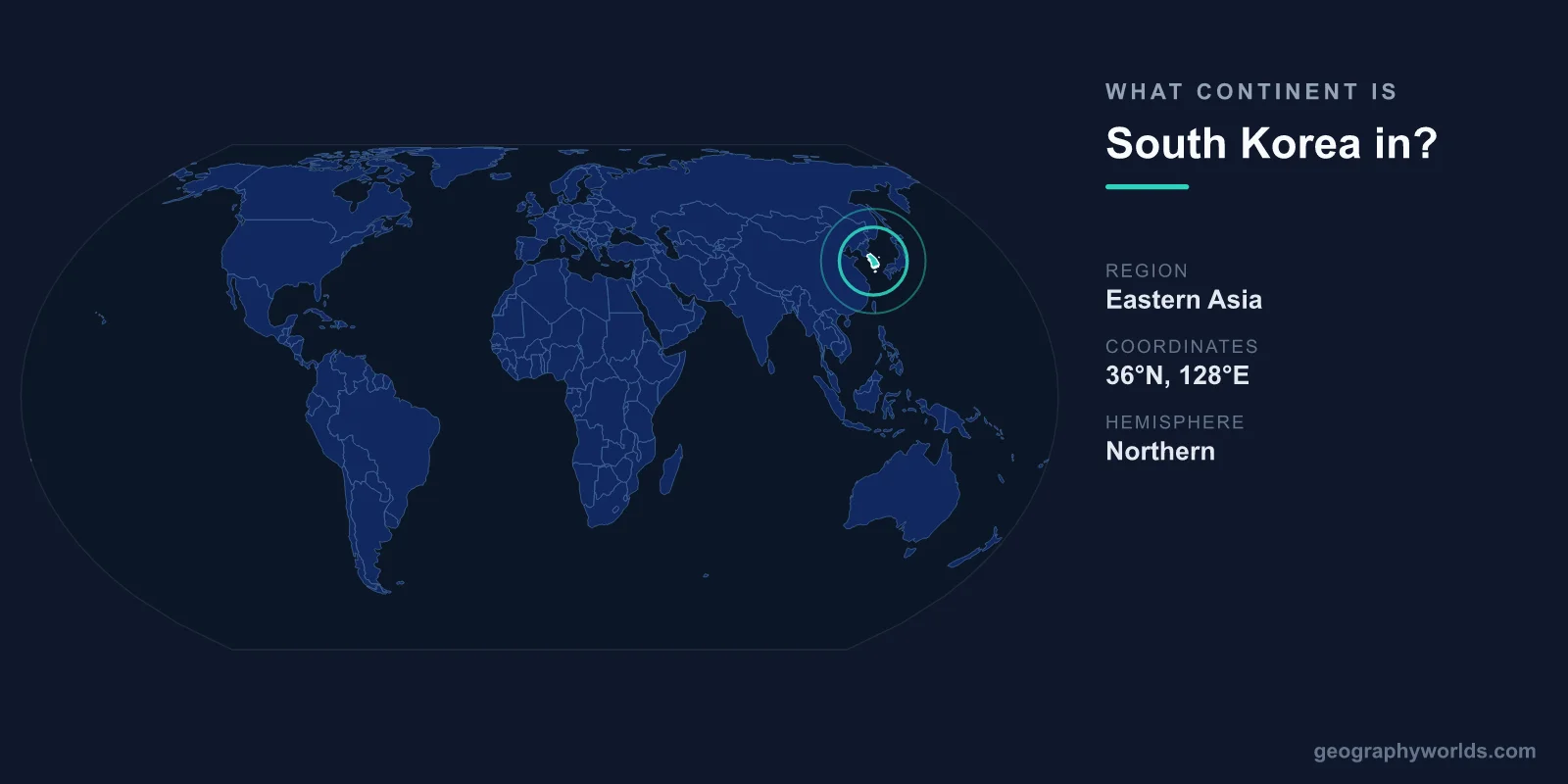
South Korea is in Asia, and more precisely it sits in the region of East Asia. Officially the Republic of Korea, it occupies the southern half of the Korean Peninsula, which juts south from the Asian mainland between China and Japan. The United Nations classifies the country as part of Eastern Asia, alongside neighbours such as China, Japan, and North Korea.
Why South Korea Belongs to Asia
Continents are defined by large, continuous landmasses, and the Korean Peninsula is firmly attached to the vast Eurasian landmass that forms Asia. South Korea is connected to the Asian mainland through the peninsula it shares with North Korea, with no ocean separating it from the continental interior. Travelling north overland from Seoul, you would pass through North Korea and into northeastern China without ever leaving Asia.
East Asia, the sub-region South Korea belongs to, also includes China, Japan, Mongolia, Taiwan, and North Korea. These countries share deep historical, cultural, and linguistic ties shaped over thousands of years, including the influence of Confucianism, the use of Chinese characters in classical writing, and dense trade networks across the region.
Where Exactly Is South Korea?
South Korea covers about 100,363 square kilometres on the southern portion of the Korean Peninsula. Its capital, Seoul, sits in the northwest along the Han River, and the greater Seoul metropolitan area is home to roughly half of the country's population of about 52 million people. Here are the essentials:
- Continent: Asia (East Asia)
- Capital: Seoul
- Area: 100,363 km²
- Coastline: roughly 2,413 km
- Highest point: Hallasan, 1,947 m, on Jeju Island
The country is bordered on land only by North Korea to the north, with the two separated by the Demilitarized Zone (DMZ) that roughly follows the 38th parallel. To the east lies the Sea of Japan (also called the East Sea), to the west the Yellow Sea, and to the south the Korea Strait, which divides South Korea from Japan.
A Peninsula Surrounded by Seas
Because South Korea sits on a peninsula, water defines much of its geography. It is surrounded on three sides by the sea, which has long made it a maritime trading nation and a hub for shipbuilding and ports such as Busan, one of the busiest container ports in the world. The western and southern coasts are dotted with thousands of small islands and feature broad tidal flats, while the eastern coast is steeper and more rugged.
The terrain is overwhelmingly mountainous: roughly 70% of the country is hills and mountains. The Taebaek range runs like a spine down the eastern side of the peninsula, pushing most of the flat, fertile farmland and the largest cities toward the western and southern lowlands. The Han River, flowing through Seoul, is one of the country's most important waterways.
South Korea's Neighbours in Asia
Every one of South Korea's neighbours is an Asian country, which reinforces its continental identity:
- North Korea — its only land neighbour, sharing the divided peninsula.
- Japan — a close maritime neighbour to the east and southeast across the Korea Strait.
- China — lies across the Yellow Sea to the west and is the region's largest country.
Jeju Island, South Korea's largest island, sits off the southern coast in the Korea Strait. It is a volcanic island formed by ancient eruptions, crowned by Hallasan, the country's tallest peak, and recognised as a UNESCO World Heritage Site. Despite being an island, it remains firmly part of Asia as South Korean territory. For a deeper look at the nation's people, economy, and culture, see our south korea country guide.
Climate and Position on the Globe
South Korea lies in the northern hemisphere, between roughly 33°N and 38°N latitude, placing it in a temperate zone. It experiences a temperate monsoon climate with four distinct seasons: cold, dry winters influenced by Siberian air masses, and hot, humid summers shaped by the East Asian monsoon, which brings most of the year's rainfall between June and August. This mid-latitude position on the eastern edge of Asia gives the country weather patterns similar to other East Asian nations rather than the tropical conditions found in Southeast Asia.
Frequently Asked Questions
Is South Korea in Asia or Europe?
South Korea is in Asia. It is located in the East Asia region on the Korean Peninsula and has no geographic connection to Europe.
Is South Korea part of East Asia or Southeast Asia?
South Korea is part of East Asia, grouped with China, Japan, Mongolia, and North Korea. Southeast Asia refers to countries farther south, such as Thailand, Vietnam, and Indonesia.
What continent is Seoul in?
Seoul, the capital of South Korea, is in Asia. It sits in the northwest of the country along the Han River, within the East Asian region.
Is South Korea connected to mainland Asia?
Yes. South Korea sits on the Korean Peninsula, which is directly attached to the Asian mainland through North Korea, so it is connected to continental Asia by land.