
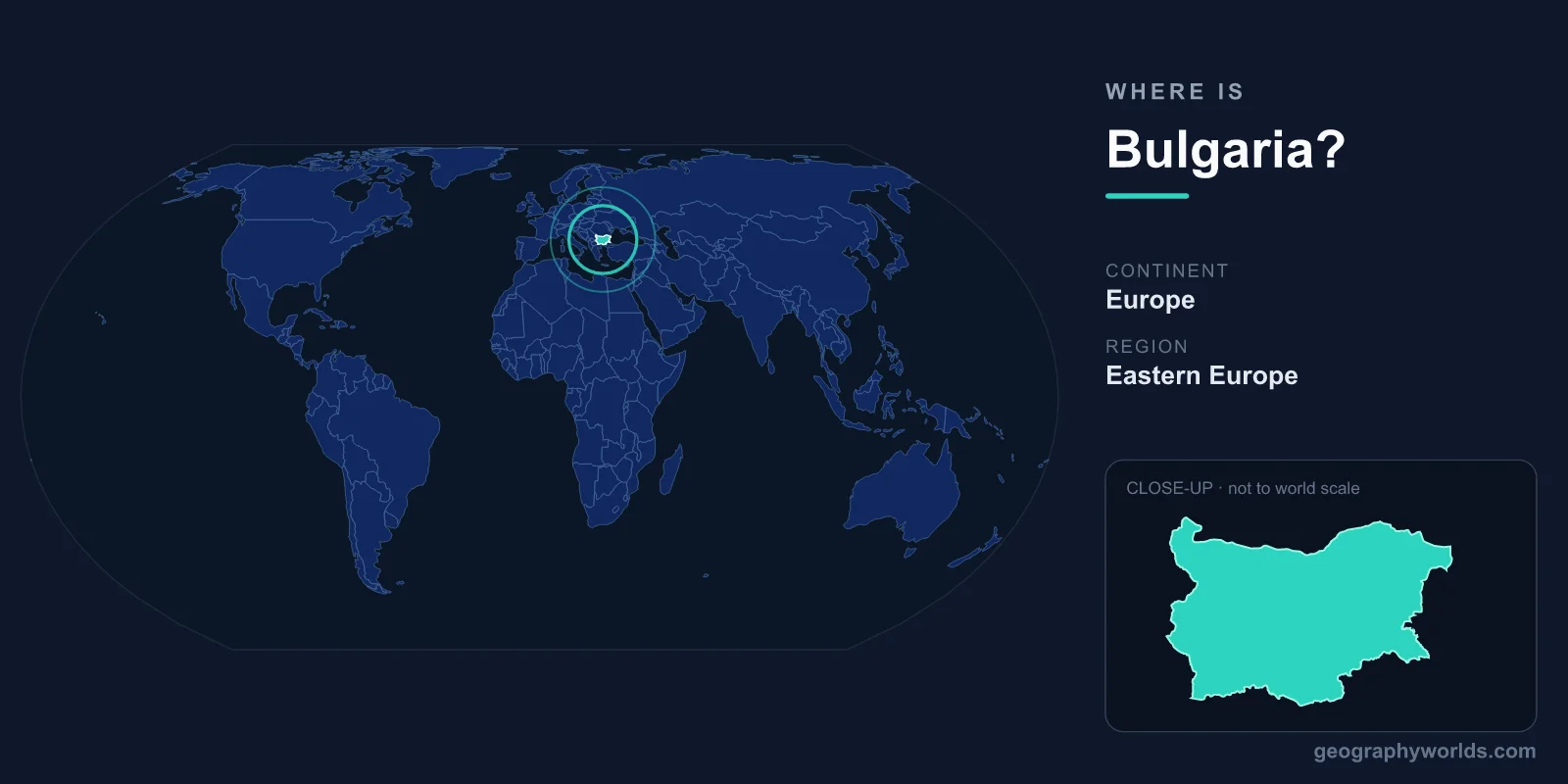
Bulgaria is located in southeastern Europe on the eastern Balkan Peninsula, bordered by the Black Sea to the east, with its capital at Sofia and a total area of about 110,879 km². It lies between roughly 41 and 44 degrees north latitude and 22 to 28 degrees east longitude, placing it firmly in the Northern and Eastern Hemispheres. Bulgaria occupies a strategic position where Europe meets Asia Minor, sitting just north of Greece and Turkey and just south of the Danube River that separates it from Romania.
Where Exactly Is Bulgaria on the Map?
If you trace a line down the eastern side of Europe, Bulgaria sits at the southeastern corner of the continent, hugging the western shore of the Black Sea. Its eastern edge is defined entirely by roughly 354 kilometres of Black Sea coastline, dotted with port cities and beach resorts such as Varna and Burgas. To the north, the broad Danube River forms most of the boundary with Romania, while the country's southern and western frontiers cut through the rugged interior of the Balkan Peninsula.
Geographers describe Bulgaria as a crossroads country. For centuries it has linked Central Europe with the Middle East and the Mediterranean with the steppes of Eurasia. Major historical trade and military routes, including the corridor along the Maritsa River valley, passed straight through Bulgarian territory, a legacy still visible in the country's roads, railways, and cultural mix. To get a feel for how Bulgaria fits among its neighbours, you can practise placing it on the map with our interactive geography games.
Which Countries Border Bulgaria?
Bulgaria shares land borders with five countries, which is why it feels so central to the Balkans. Each neighbour connects Bulgaria to a different sphere of influence, from the European Union to the gateway to Asia.
- Romania – to the north, largely along the Danube River.
- Serbia – to the northwest, through mountainous terrain.
- North Macedonia – to the west.
- Greece – to the south, across the Rhodope and other ranges.
- Turkey – to the southeast, marking the land bridge toward Asia.
The borders with Greece and Turkey make Bulgaria part of the European Union's external frontier with Asia Minor, while the Black Sea coast opens the country toward Georgia, Ukraine, and beyond by sea.
The Landscape: Mountains, Rivers, and Coast
For a country of moderate size, comparable in area to Iceland or the U.S. state of Ohio, Bulgaria packs in remarkable variety. The Balkan Mountains, known locally as the Stara Planina, run east to west across the centre of the country and historically gave the entire peninsula its name. To the southwest rise the Rila and Pirin ranges, home to Musala, which at 2,925 metres is the highest peak in the entire Balkan Peninsula.
Between the mountains lie fertile lowlands. The Danubian Plain stretches across the north, while the Upper Thracian Plain in the south is a key agricultural region famous for the Rose Valley near Kazanlak, where much of the world's rose oil is produced. The Maritsa is the country's most important interior river, and the Iskar is the longest river running entirely within Bulgaria. This blend of highland and lowland creates distinct microclimates, supporting everything from vineyards and orchards to alpine meadows and pine forests.
Capital, People, and Everyday Life
Sofia, set in a valley at the foot of Vitosha Mountain in the west of the country, is Bulgaria's capital and largest city as well as its political, economic, and cultural heart. The nation is home to roughly 6.5 to 7 million people, the large majority of whom are ethnic Bulgarians, alongside Turkish and Roma minorities. The official language is Bulgarian, a Slavic language written in the Cyrillic alphabet, which was developed in the Bulgarian lands in the 9th and 10th centuries and later spread across the Slavic world.
The dominant religion is Eastern Orthodox Christianity, expressed through the Bulgarian Orthodox Church, and Islam is the largest minority faith. Bulgaria is a parliamentary republic and has been a member of the European Union since 2007. As of 1 January 2026 the country adopted the euro as its currency, replacing the long-standing Bulgarian lev. For a deeper look at the nation's history, regions, and travel highlights, see our full bulgaria country guide.
Frequently Asked Questions
Is Bulgaria in Europe or Asia?
Bulgaria is entirely in Europe. It lies in the southeastern part of the continent on the Balkan Peninsula. However, its southeastern border with Turkey places it right at the doorstep of Asia Minor, which is why it has long been seen as a bridge between the two.
What sea borders Bulgaria?
The Black Sea forms Bulgaria's entire eastern boundary, giving the country roughly 354 kilometres of coastline. Popular coastal cities and resorts include Varna, Burgas, Sunny Beach, and the historic town of Nessebar.
What is the capital of Bulgaria?
The capital of Bulgaria is Sofia, located in the western part of the country near Vitosha Mountain. It is the largest city and the centre of government, business, and culture, with origins stretching back thousands of years.
What continent is Bulgaria on?
Bulgaria is on the continent of Europe, specifically in the Southeastern Europe or Balkans region. It sits in both the Northern and Eastern Hemispheres.