
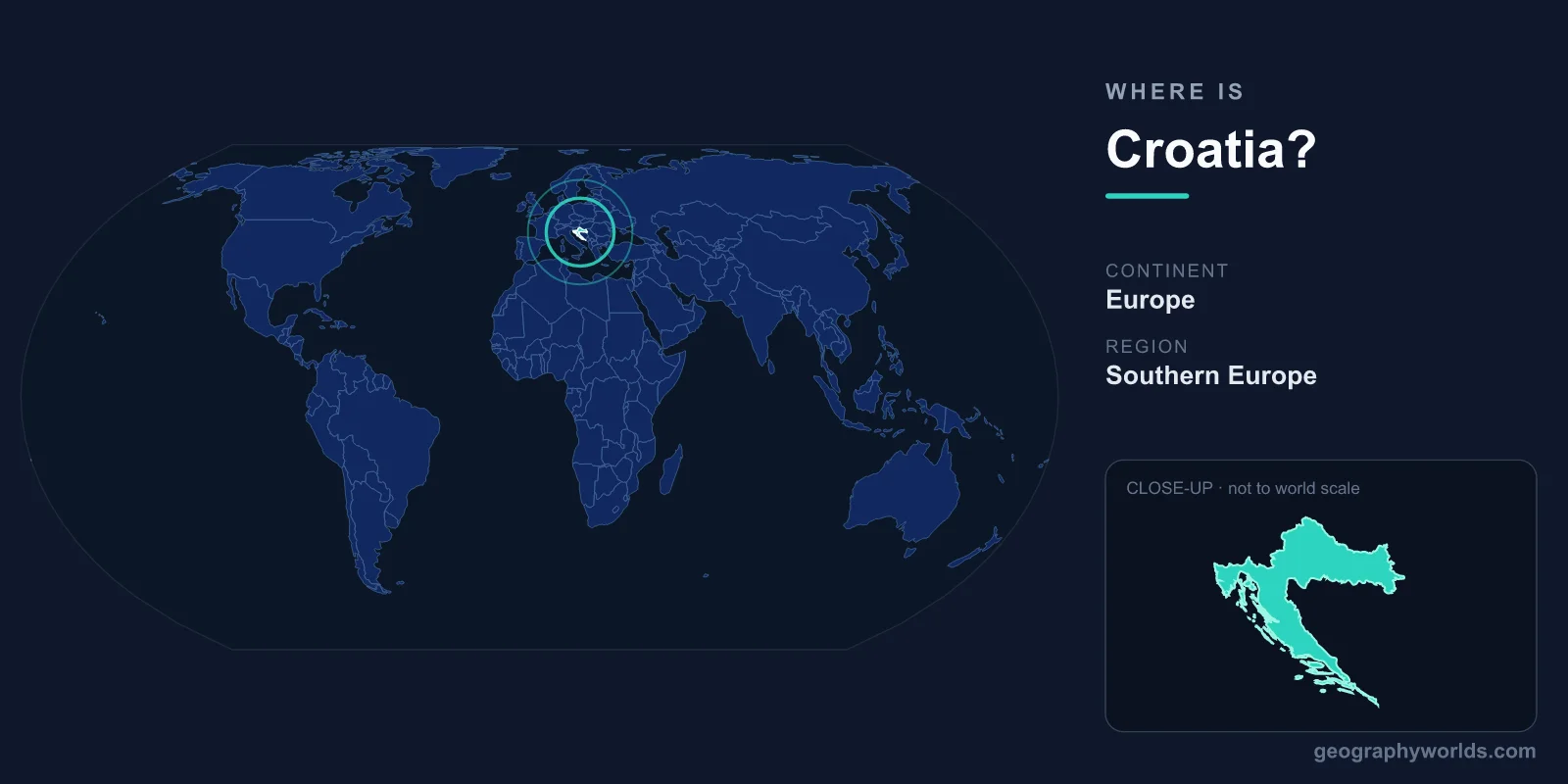
Croatia is located in southeastern Europe, sitting along the eastern shore of the Adriatic Sea between Central Europe, the Balkan Peninsula, and the Mediterranean. The country has a distinctive crescent or boomerang shape that curves down from the Pannonian plains around the Dinaric mountains and out along a long, island-strewn coastline. Its capital, Zagreb, lies inland in the north, and the nation covers roughly 56,594 km².
Where Croatia Sits on the Map
Croatia lies in the Northern and Eastern Hemispheres, between roughly 42 and 46 degrees north latitude and 13 and 20 degrees east longitude. That puts it on the same latitude band as central Italy and southern France, giving the coast a warm Mediterranean climate while the interior feels more continental. The country is a crossroads where the Central European world of the former Austro-Hungarian lands meets the Mediterranean and the Balkans.
Because of its narrow, curving form, Croatia stretches a long way despite its modest size. The coastline runs for hundreds of kilometres down the Adriatic, while the mainland never sits far from either the sea or the mountains. This shape is one reason the country feels far larger to travellers than its area suggests, and why no single region defines it.
Bordering Countries and the Adriatic Sea
Croatia shares land borders with five countries and a long maritime frontier with Italy across the Adriatic. Its neighbours are:
- Slovenia – to the northwest, toward the Alps and Central Europe
- Hungary – to the northeast, across the flat Pannonian Basin
- Serbia – to the east, along the Danube river region
- Bosnia and Herzegovina – to the southeast, the longest of Croatia's borders
- Montenegro – to the far south, near Dubrovnik
A geographic quirk worth knowing: the short coastal town of Neum in Bosnia and Herzegovina splits Croatia's southern coast in two, separating the Dubrovnik region from the rest of the mainland. The Pelješac Bridge, opened in 2022, now reconnects these two stretches of Croatian territory without crossing an international border.
A Coastline of More Than a Thousand Islands
Croatia's defining feature is its Adriatic coastline, one of the most indented in the world. The country claims well over a thousand islands, islets, and rocky outcrops, though only a few dozen are permanently inhabited. Larger islands such as Krk, Cres, Brač, Hvar, and Korčula draw millions of visitors each summer.
The terrain is strikingly varied for such a compact country. The Dinaric Alps run parallel to the coast, creating a dramatic wall of limestone karst that drops toward the sea. Inland to the northeast, the land flattens into fertile lowlands that are well suited to farming. This combination of mountains, plains, and a long coast packs an unusual range of landscapes into a small area.
Iconic Places and Landmarks
Croatia's geography has shaped some of Europe's most recognisable destinations. The walled old city of Dubrovnik, perched on the southern Adriatic, is famous for its intact medieval ramparts. Further north, the port city of Split is built around the Roman emperor Diocletian's palace, while Zagreb anchors the cultural and political life of the interior.
The karst landscape also produces natural wonders, most notably Plitvice Lakes National Park, where a chain of terraced turquoise lakes is linked by waterfalls. These sites reflect how closely Croatia's appeal is tied to where it sits: at the meeting point of Mediterranean coast and mountainous Balkan interior. For more detail on the country's regions, history, and travel highlights, see our croatia country guide.
People, Language, and Currency
Croatia is home to roughly four million people. The official language is Croatian, written in the Latin alphabet, and the majority of the population identifies as Roman Catholic, a tradition that shapes festivals and daily life. The country is a parliamentary republic and has been a member of the European Union since 2013. In January 2023 it adopted the euro as its currency and joined the Schengen passport-free travel zone, tightening its ties to the rest of Europe.
Frequently Asked Questions
What continent is Croatia on?
Croatia is in Europe, specifically the southeastern part of the continent, along the Adriatic coast where Central Europe, the Mediterranean, and the Balkans meet.
Is Croatia part of the Balkans?
Yes, Croatia lies on the Balkan Peninsula, though it also has strong Central European and Mediterranean characteristics. Many Croatians see their country as straddling several regions rather than belonging to just one.
What sea is Croatia on?
Croatia sits on the Adriatic Sea, an arm of the Mediterranean. Italy lies directly across the water to the west, and Croatia's heavily indented coast includes more than a thousand islands.
What is the capital of Croatia?
The capital is Zagreb, located inland in the north of the country. It is the largest city and serves as Croatia's political, economic, and cultural centre.