
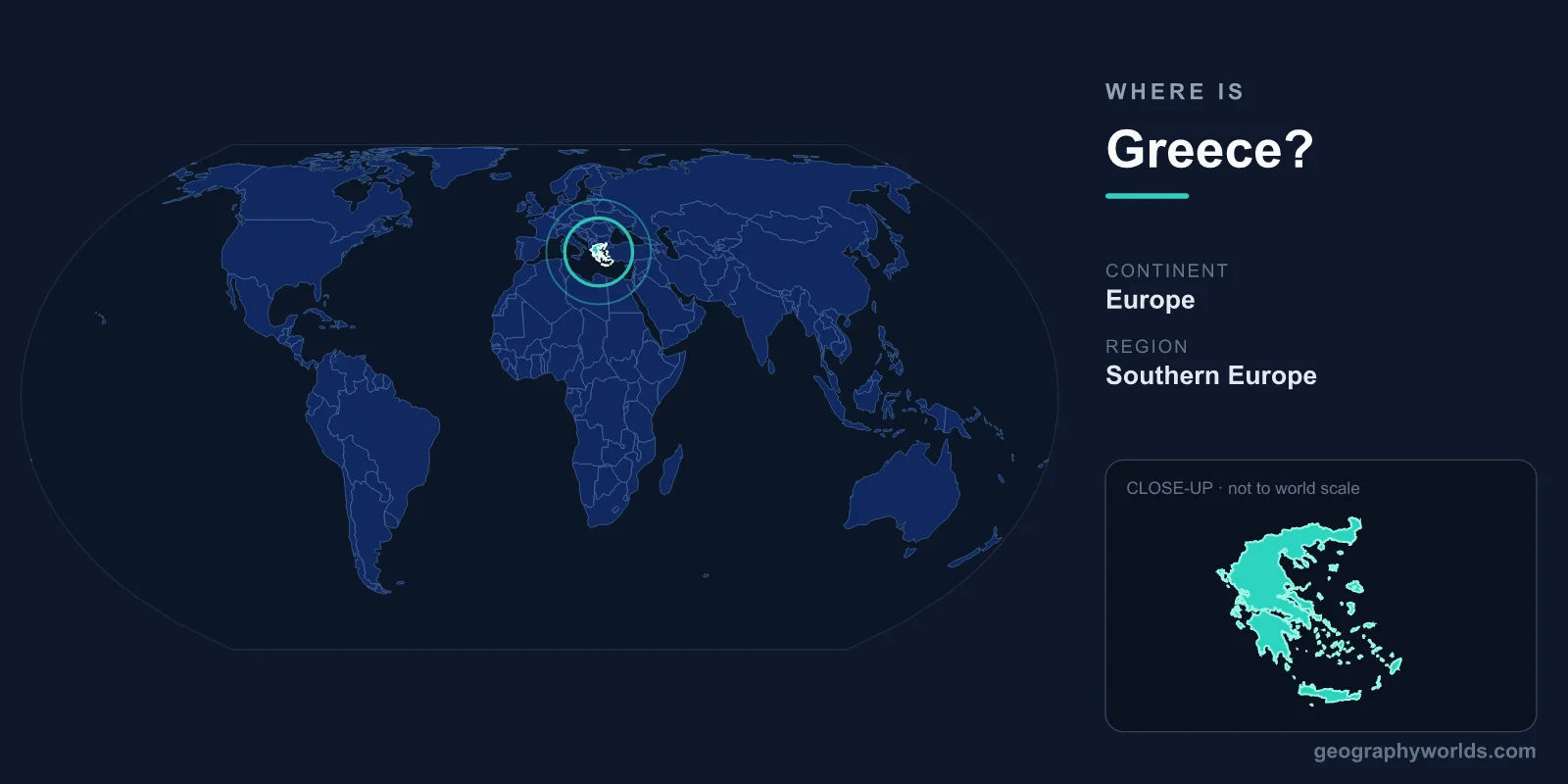
Greece is located at the southern tip of the Balkan Peninsula in southeastern Europe, bordered by Albania, North Macedonia, and Bulgaria to the north, Turkey to the northeast, and surrounded by the Aegean, Ionian, and Mediterranean Seas. Its capital is Athens, the country covers roughly 131,957 km², and it sits in both the Northern and Eastern Hemispheres at a historic crossroads between Europe, Asia, and Africa.
Where Exactly Is Greece on the Map?
Greece occupies the southernmost reach of the Balkan Peninsula, lying roughly between 35 degrees and 42 degrees north latitude and 19 degrees to 28 degrees east longitude. Athens, the capital, sits near the southeastern edge of the mainland at about 38 degrees north, on the Attica peninsula beside the Saronic Gulf.
This location gives Greece a dual identity. It is European in politics and culture, yet it faces the Eastern Mediterranean and lies only a short stretch of water from Asia Minor (modern Turkey), with the North African coast not far to the south. For thousands of years that position has made Greece a natural bridge between continents and a meeting point of civilizations.
Greece's Borders and Neighbors
Greece shares land borders with four countries, all along its northern and northeastern frontier:
- Albania to the northwest
- North Macedonia to the north
- Bulgaria to the northeast
- Turkey to the far northeast, where the border follows the Evros (Maritsa) River through the region of Thrace
Everywhere else, Greece is framed by water. The Ionian Sea lies to the west, facing Italy, the Aegean Sea stretches to the east between Greece and Turkey, and the wider Mediterranean Sea opens to the south. This maritime setting gives Greece one of the longest coastlines of any country in the world, exceeding 13,000 kilometers once all of its islands are counted.
The Mainland and the Islands
Greece is unusually fragmented for its size, and its geography divides into several distinct parts. The mainland is dominated by mountains, with the rugged Pindus range running down its spine, and includes regions such as Macedonia, Thessaly, Epirus, and Central Greece. The southern Peloponnese peninsula is connected to the rest of the country only by the narrow Isthmus of Corinth, now severed by a famous canal. Mount Olympus, the mythological home of the gods, rises to nearly 2,918 meters and is the highest point in the country.
Beyond the mainland lie thousands of islands and islets, of which only a couple of hundred are inhabited. They fall into well-known groups such as the Cyclades, the Dodecanese, the Ionian Islands, and the Sporades. Crete, far to the south, is the largest Greek island and a region in its own right, followed in size by Euboea. This scattering of islands across the Aegean and Ionian seas gives Greece much of its distinctive shape and character.
Why Greece's Location Matters
Greece's position where Europe, Asia, and Africa converge has shaped its entire history. Ancient city-states such as Athens, Sparta, and Corinth built trading networks across the Mediterranean, founding colonies as distant as modern Italy, France, and the Black Sea coast. Later the same location placed Greece at the heart of the Byzantine Empire and astride the routes linking East and West.
That geography still carries weight today. Greece is a member of the European Union and NATO, and its southeastern frontier forms part of Europe's external border. Its harbors, especially Piraeus near Athens, rank among the busiest in the Mediterranean. The country uses the Euro as its currency, operates as a parliamentary republic, and has a population of roughly 10 million people, the large majority of whom speak Greek and belong to the Greek Orthodox Christian tradition. Its climate is classically Mediterranean: hot, dry summers and mild, wet winters along the coasts, with cooler conditions and snow in the higher mountains. For a deeper look at the country's regions and culture, see our greece country guide.
Frequently Asked Questions
What continent is Greece in?
Greece is in Europe, specifically in the southeastern part of the continent on the Balkan Peninsula. Because of its location and islands it sits close to both Asia and Africa, but it is firmly European in political and cultural terms.
Is Greece in Europe or Asia?
Greece is in Europe and is a member of the European Union. While its eastern Aegean islands lie just off the coast of Asia Minor (Turkey) and the country has long connected the two continents, all Greek territory is considered part of Europe.
What is the capital of Greece and where is it?
The capital is Athens, located in the Attica region near the southeastern coast of the mainland, beside the Saronic Gulf. It is the country's largest city and its political, economic, and cultural center, home to ancient landmarks such as the Parthenon on the Acropolis.
How big is Greece?
Greece covers about 131,957 km², roughly comparable in area to England or the U.S. state of Alabama. Despite this moderate land area, its thousands of islands and deeply indented coastline give it a geographic footprint far larger than the numbers alone suggest.