
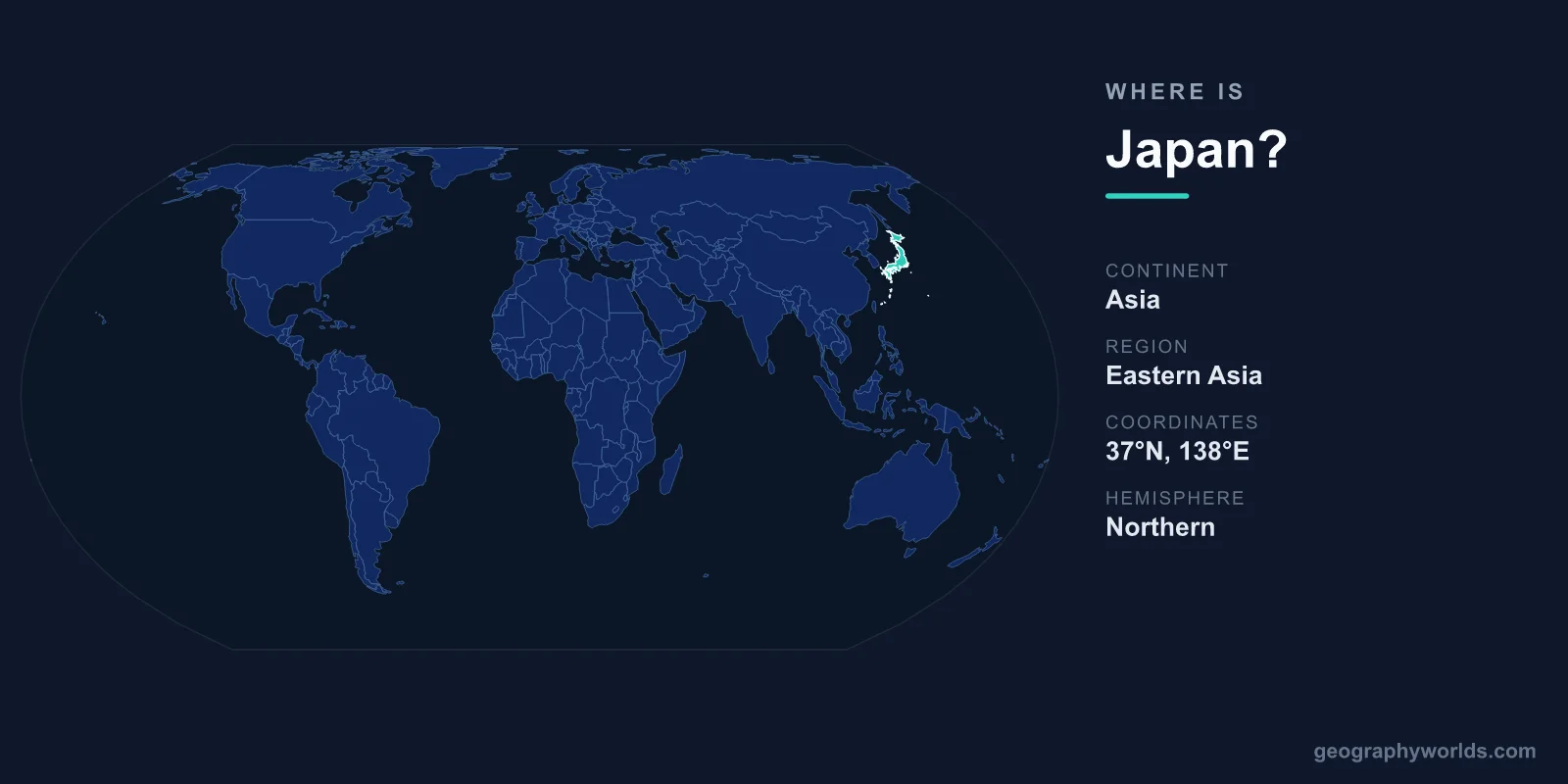
Japan is an island nation in East Asia, lying off the eastern coast of the Asian mainland in the North Pacific Ocean and separated from Korea, China, and Russia by the Sea of Japan. It is an archipelago of four main islands and thousands of smaller ones, covering roughly 377,975 square kilometres, with Tokyo as its capital. Sitting along the Pacific Ring of Fire, Japan stretches in a long arc across the Northern and Eastern Hemispheres.
Where Japan Sits on the Map
Japan lies between roughly 24 and 46 degrees north latitude and 123 and 146 degrees east longitude, placing it firmly in the temperate zone of East Asia. The country forms a curving chain that runs from the southwest to the northeast, parallel to the Asian coastline but never touching it. To the west, the Sea of Japan separates the archipelago from the Korean Peninsula and the Russian Far East; to the east lies the vast open expanse of the Pacific Ocean.
This position gives Japan a remarkable north-to-south range. Its northern island of Hokkaido experiences cold, snowy winters comparable to parts of Canada, while the southern Ryukyu Islands, including Okinawa, enjoy a subtropical climate closer to that of Taiwan. Because of this latitude span, the whole country lies east of mainland Asia and well out into the Pacific.
The Four Main Islands
Japan's land area is concentrated on four principal islands, arranged from north to south:
- Honshu — the largest and most populous island, home to Tokyo, Osaka, Kyoto, and the iconic Mount Fuji.
- Hokkaido — the northernmost main island, known for cold winters, open landscapes, and the city of Sapporo.
- Kyushu — the southwestern island, closest to the Asian mainland and dotted with active volcanoes.
- Shikoku — the smallest of the four, nestled south of Honshu across the Seto Inland Sea.
Beyond these, Japan includes thousands of smaller islands, among them the Ryukyu chain that arcs southwest toward Taiwan. The four main islands are knitted together by an extensive network of bridges, tunnels, and ferries, including the Seikan Tunnel, one of the longest undersea rail tunnels in the world, which links Honshu and Hokkaido.
Does Japan Border Any Countries?
As an island nation, Japan shares no land borders with any other country. Instead, its frontiers are entirely maritime. Its nearest neighbours across the water are South Korea and North Korea to the west, China and Taiwan to the southwest, and Russia to the north. The narrowest gap is the Korea Strait, where only about 200 kilometres of sea separate the Japanese island of Kyushu from the southern tip of Korea.
This geographic separation has shaped Japan's history profoundly. For long stretches of its past the surrounding seas acted as a natural moat, allowing distinctive cultural, linguistic, and political traditions to develop with limited outside interference, while still permitting trade and exchange with the Asian continent.
A Landscape Shaped by the Ring of Fire
Japan sits at the meeting point of several tectonic plates along the Pacific Ring of Fire, which explains both its mountainous terrain and its frequent earthquakes and volcanoes. About three-quarters of the country is hilly or mountainous, so most of the population is packed onto narrow coastal plains, the largest being the Kanto Plain around Tokyo.
The most famous of Japan's many volcanoes is Mount Fuji, which rises 3,776 metres on Honshu and is the country's highest peak. Hot springs, known as onsen, are found across the islands, a direct benefit of the same volcanic activity that occasionally brings hazards. The long, indented coastline gives Japan one of the largest exclusive economic zones in the world, and fishing has been central to its diet and economy for centuries.
People, Capital, and Time Zone
Tokyo, on the Pacific side of central Honshu beside Tokyo Bay, is Japan's capital and the centre of one of the most populous metropolitan regions on Earth. The country is home to roughly 125 million people, the vast majority of whom speak Japanese. Shinto and Buddhism are the two most widely followed religious traditions, often practised side by side, and the national currency is the Japanese yen.
Japan observes a single time zone, Japan Standard Time (UTC+9), with no daylight saving. Because it lies so far east, it is among the first major countries to greet each new day — a fact reflected in its old description as the "Land of the Rising Sun." For a fuller overview of the country's regions, history, and travel highlights, see our japan country guide.
Frequently Asked Questions
What continent is Japan on?
Japan is part of the continent of Asia, specifically the East Asia region. Although it is an island nation separated from the mainland, it is grouped geographically and culturally with continental East Asia.
Is Japan closer to China or Korea?
Japan is closer to Korea. The Korea Strait separates Japan's island of Kyushu from southern Korea by only about 200 kilometres, while mainland China lies farther west across the East China Sea.
How many islands does Japan have?
Japan is made up of thousands of islands, but four main ones — Honshu, Hokkaido, Kyushu, and Shikoku — account for the great majority of its land area and population.
What are the coordinates of Japan?
Japan spans roughly 24 to 46 degrees north latitude and 123 to 146 degrees east longitude. Tokyo, the capital, sits at about 35.7 degrees north and 139.7 degrees east.