
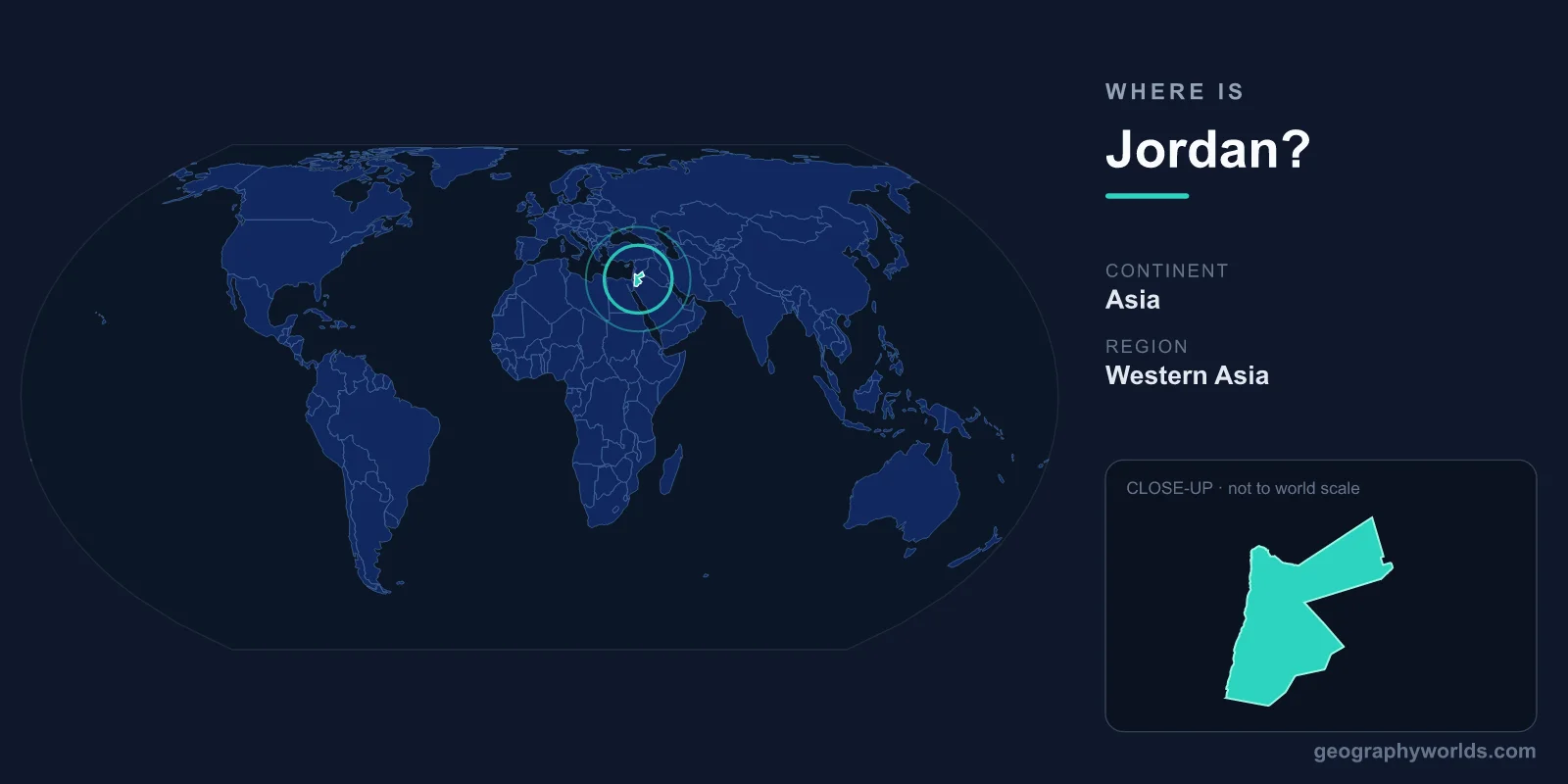
Jordan is located in the Middle East region of western Asia, bordered by Syria to the north, Iraq to the northeast, Saudi Arabia to the east and south, and Israel and the West Bank to the west, with a short coastline on the Red Sea's Gulf of Aqaba. Its capital is Amman, and the country covers roughly 89,342 square kilometres, placing it among the smaller nations of the region in land area but at the heart of one of the world's most historically significant crossroads.
Where Exactly Is Jordan on the Map?
Jordan sits in the Northern and Eastern Hemispheres, between approximately 29° and 33° north latitude and 35° and 39° east longitude. It is a landlocked country in all but one corner: its only access to the sea is a narrow 26-kilometre stretch of coast at Aqaba, on the northeastern tip of the Red Sea. This sliver of coastline gives Jordan a vital maritime gateway and its only seaport.
The country lies at the meeting point of three continents' trade routes, historically connecting Europe, Asia, and Africa. To its west runs the Jordan River and the Dead Sea, which form much of the boundary with Israel and the West Bank. To the south and east stretch the vast deserts that merge into the Arabian Peninsula. In terms of size, Jordan is comparable to Portugal, Hungary, or the US state of Indiana.
Countries That Border Jordan
Jordan shares land borders with four sovereign states plus the Palestinian West Bank, making it a true regional hub. These boundaries have shaped Jordan's role as a corridor for trade, pilgrimage, and the movement of peoples for thousands of years.
- Syria – to the north, sharing a roughly 375-kilometre frontier.
- Iraq – to the northeast, along a desert border in the east.
- Saudi Arabia – Jordan's longest border, running along the east and south.
- Israel – to the west, much of it following the Jordan River, Dead Sea, and Wadi Araba.
- The West Bank – the Palestinian territory adjoining Jordan's western edge across the Jordan River.
This central position has made Jordan a place of refuge and exchange, but also exposed it to the political currents of the surrounding region.
Jordan's Landscape and Geographic Regions
Despite its modest size, Jordan packs in striking geographic variety. The land divides broadly into three zones: the Jordan Rift Valley in the west, the highland plateau running north to south, and the desert that covers more than three-quarters of the country to the east.
The Jordan Valley contains the Dead Sea, whose shoreline lies around 430 metres below sea level — the lowest point on Earth's land surface. Its hypersaline waters are so dense that swimmers float effortlessly. Rising eastward, the highlands around Amman, Madaba, and Karak enjoy a Mediterranean-style climate and hold most of the population and farmland. Further south, the desert of Wadi Rum reveals dramatic sandstone mountains and red dunes, while the ancient rock-cut city of Petra — carved by the Nabataeans more than 2,000 years ago — remains Jordan's most celebrated landmark and a UNESCO World Heritage Site.
People, Capital, and Everyday Life
Jordan is home to roughly 11 million people, with the great majority living in the urbanised northwest. Amman, the capital, is the largest city and the political, economic, and cultural centre, built across a series of hills that give it the nickname "the city of seven jabals." Other important cities include Zarqa, Irbid, and the Red Sea resort of Aqaba.
Arabic is the official language, and Islam, predominantly Sunni, is the dominant religion, though Jordan has a long-established Christian minority. The country is a constitutional monarchy with a parliamentary system, governed by a king alongside an elected legislature. The national currency is the Jordanian dinar (JOD). For a deeper look at the nation's history, economy, and travel highlights, see our jordan country guide.
Why Jordan's Location Matters
Jordan's position at the junction of the Levant and the Arabian Peninsula has given it outsized strategic importance. It sits along historic caravan and pilgrimage routes, and today serves as a relatively stable bridge between often-turbulent neighbours. Its limited Red Sea access at Aqaba links it to global shipping lanes through the Suez Canal, while its highlands and valleys support agriculture and a thriving tourism industry centred on Petra, the Dead Sea, and Wadi Rum.
Frequently Asked Questions
What continent is Jordan in?
Jordan is located on the continent of Asia, specifically in the Middle East (or Levant) region of western Asia, near the boundary with the Arabian Peninsula.
Is Jordan landlocked?
Jordan is almost entirely landlocked. Its only coastline is a short 26-kilometre stretch on the Gulf of Aqaba at the northern end of the Red Sea, where the port city of Aqaba is located.
What is the capital of Jordan?
The capital of Jordan is Amman, which is also the country's largest city and its main political, commercial, and cultural centre.
How big is Jordan?
Jordan covers approximately 89,342 square kilometres, making it similar in size to Portugal or Hungary. More than three-quarters of that area is desert.