
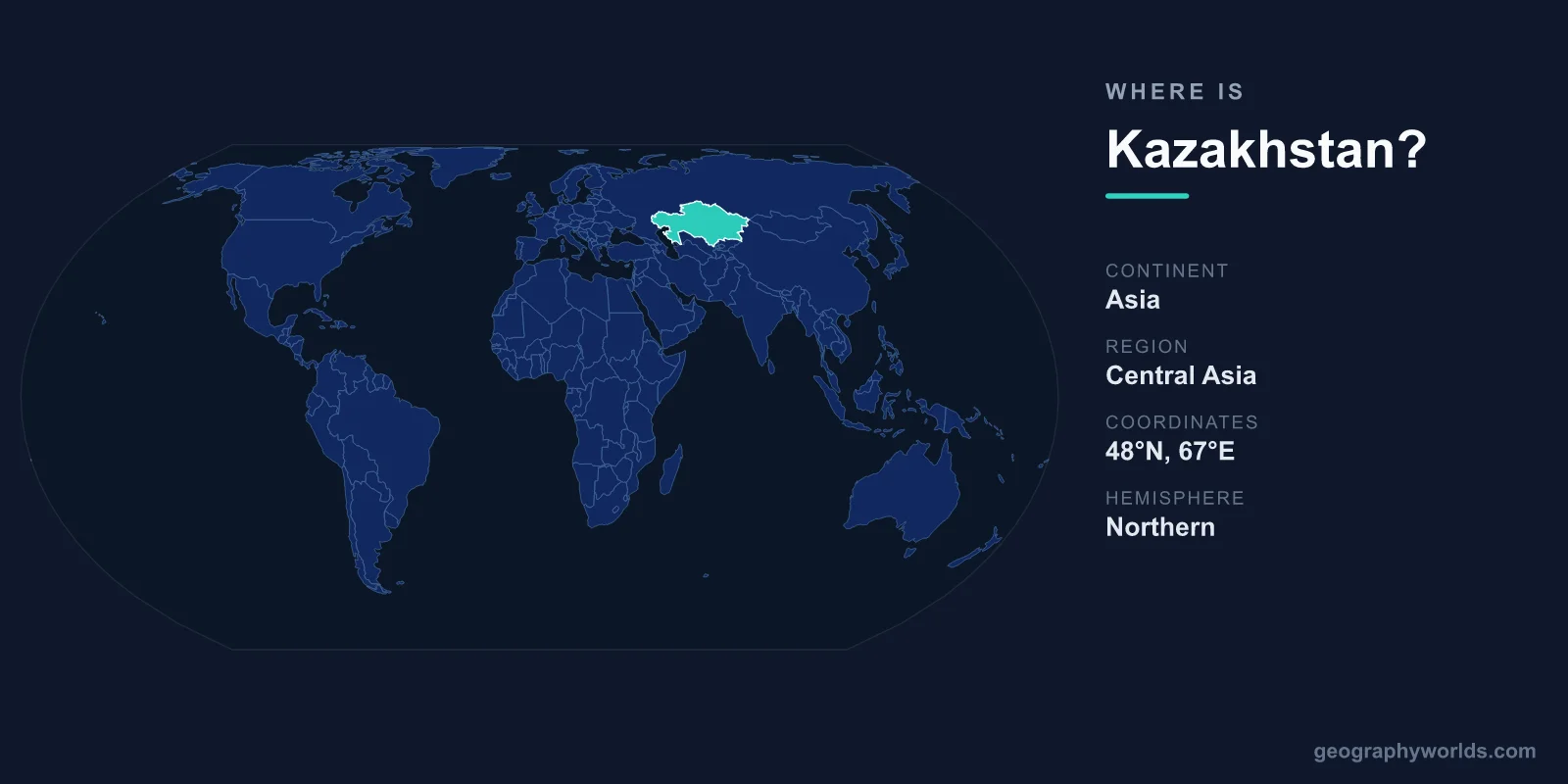
Kazakhstan is located in Central Asia, straddling the boundary between Asia and Europe, and is the world's largest landlocked country at 2,724,900 km². It stretches from the Caspian Sea in the west to the Altai Mountains along the Chinese border in the east, and from the Siberian plains of Russia in the north down to the deserts of Central Asia in the south. Its capital is Astana, and roughly 19 million people live across this enormous, sparsely populated expanse.
Where Exactly Is Kazakhstan on the Map?
Kazakhstan sits in the Northern and Eastern Hemispheres, occupying a central position in the Eurasian landmass. The country lies roughly between 40 and 55 degrees north latitude and 46 to 88 degrees east longitude. Most of Kazakhstan falls within Asia, but a small portion west of the Ural River is considered part of Europe, making Kazakhstan a transcontinental country.
To picture its scale, Kazakhstan is larger than all of Western Europe combined and ranks as the ninth-largest country on Earth by area. Despite this vastness, it has no access to the open ocean. Its only major bodies of water are the landlocked Caspian Sea to the west and the shrinking Aral Sea to the southwest, which is why it is described as the largest landlocked nation in the world.
Which Countries Border Kazakhstan?
Kazakhstan shares land borders with five countries, placing it at a strategic crossroads between Russia, China, and the rest of Central Asia:
- Russia – along the entire northern frontier, one of the longest continuous land borders in the world
- China – to the east, across the Tian Shan and Altai mountain regions
- Kyrgyzstan – to the southeast
- Uzbekistan – to the south
- Turkmenistan – to the southwest
This central location has shaped Kazakhstan's identity for centuries. The historic Silk Road trade routes passed through its territory, linking China with the Middle East and Europe. Today the country continues that legacy as a key transit hub for overland trade and energy pipelines between Asia and Europe.
The Landscape: From Steppe to Mountains
Because of its size, Kazakhstan contains a remarkable variety of terrain. The defining feature is the vast Kazakh Steppe, an immense band of dry grassland that covers much of the central and northern parts of the country and forms one of the largest dry steppe regions on the planet. This open, treeless plain gives way to several distinct environments in other regions:
- Deserts and semi-deserts dominate the south and southwest, including the Betpak-Dala and the sands near the Aral Sea.
- High mountains rise in the east and southeast, where the Tian Shan and Altai ranges reach elevations above 6,000 metres near the borders with China and Kyrgyzstan.
- Lowlands along the Caspian shore include the Caspian Depression, parts of which sit below sea level.
This range of landscapes means Kazakhstan spans multiple climate zones, from cold continental winters on the northern steppe to hot, arid summers in the southern deserts. The country is also home to the Baikonur Cosmodrome, the world's first and largest space launch facility, located in the southern steppe.
Astana and the Major Cities
Kazakhstan's capital, Astana, lies in the north-central part of the country on the Ishim River. It became the capital in 1997, replacing the former capital Almaty, and is known for its striking modern architecture, including the landmark Bayterek Tower. Almaty, in the far southeast near the Tian Shan foothills, remains the largest city and the financial and cultural heart of the nation. Other important cities include Shymkent in the south and the western oil city of Atyrau on the Caspian Sea.
The population is concentrated unevenly, with denser settlement in the south and along the northern border, while the central steppe remains thinly populated. Kazakh and Russian are both widely spoken, and Islam is the most practised religion. To learn more about the country's regions, economy, and culture, see our kazakhstan country guide.
Frequently Asked Questions
Is Kazakhstan in Asia or Europe?
Kazakhstan is primarily in Asia, in the region known as Central Asia. However, a small western portion beyond the Ural River lies in Europe, so it is officially a transcontinental country spanning both continents.
Is Kazakhstan landlocked?
Yes. Kazakhstan is the largest landlocked country in the world. It borders the Caspian Sea, but because the Caspian is an enclosed inland sea with no connection to the open ocean, the country has no maritime access to international waters.
What is the capital of Kazakhstan?
The capital is Astana, located in the north-central part of the country. It has been the capital since 1997, when the seat of government moved there from Almaty, which remains the largest city.
What countries are near Kazakhstan?
Kazakhstan borders five countries: Russia to the north, China to the east, and Kyrgyzstan, Uzbekistan, and Turkmenistan to the south and southwest.