
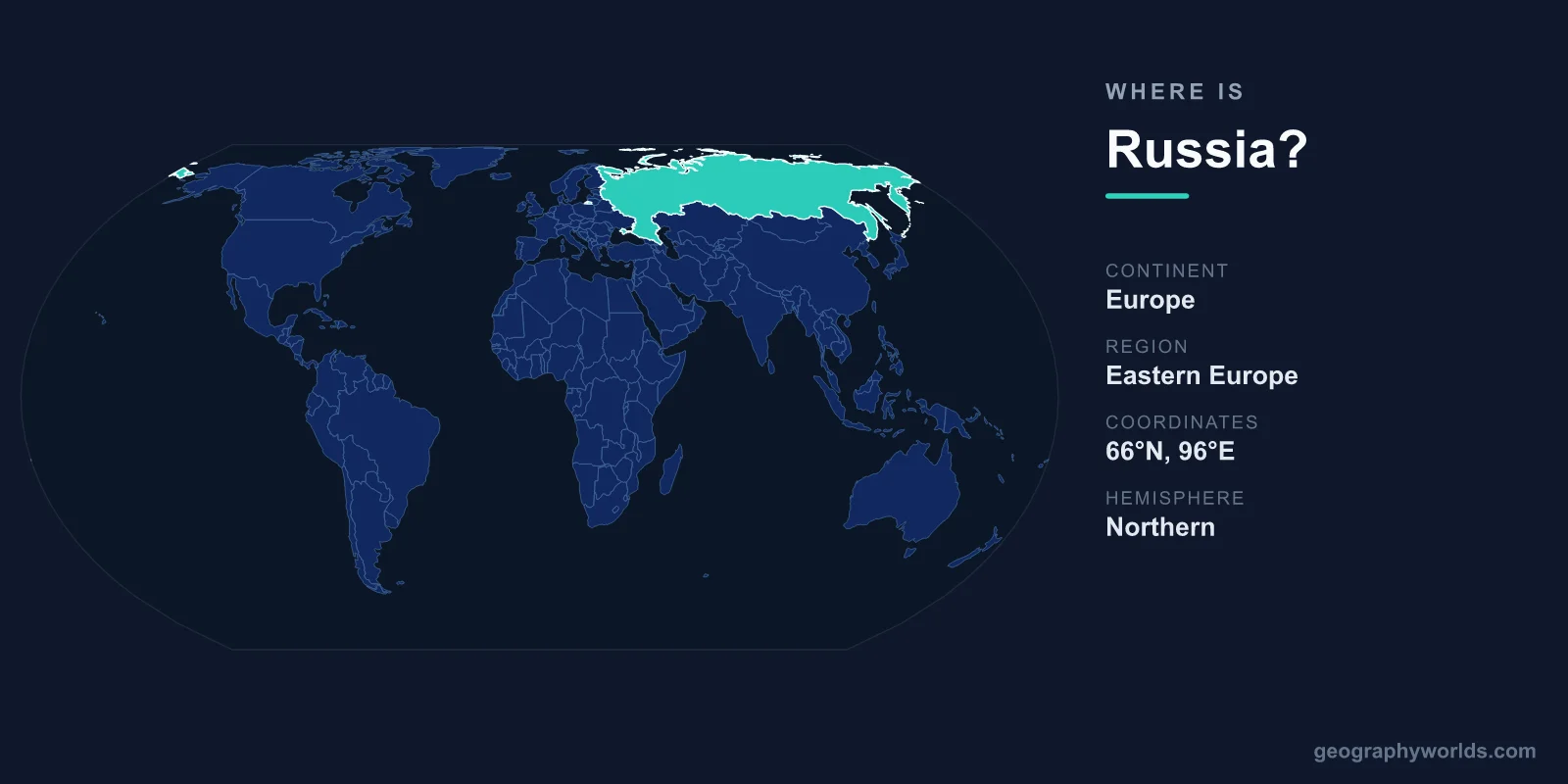
Russia lies across the northern reaches of Eurasia, stretching from Eastern Europe all the way to the Pacific coast of Northern Asia, which makes it the largest country on Earth at 17,098,242 km². Its capital, Moscow, sits in the European west of the country, while its eastern tip almost touches Alaska across the Bering Strait. No other nation spans such a sweep of the globe.
Where Exactly Is Russia on the Map?
Russia occupies the far north of the Eastern Hemisphere, sitting entirely above the Equator in the Northern Hemisphere. Its western edge borders the Baltic Sea and several European neighbours, while its long northern coast faces the Arctic Ocean. To the east, the country reaches the Pacific Ocean, looking out toward Japan and the United States. Because Russia covers so much longitude, it is conventionally split into a smaller European section, west of the Ural Mountains, and a far larger Asian section known as Siberia and the Russian Far East.
This east-west extent is so great that Russia spans eleven time zones. When it is breakfast time in Moscow, people in the Pacific city of Vladivostok are already finishing dinner. That single fact captures just how vast and geographically unusual the country is. To explore more about the nation, see our russia country guide.
Which Continent Is Russia On?
Russia is a transcontinental country, meaning it sits on two continents at once: Europe and Asia. The traditional dividing line runs along the Ural Mountains, the Ural River, and the Caspian Sea. About a quarter of Russia's land area lies west of this line in Europe, yet that smaller European portion is home to the large majority of the population, including Moscow and Saint Petersburg.
The remaining three-quarters of the territory belong to Asia. This includes the immense forests, tundra, and frozen plains of Siberia, a region so large that if it were an independent country it would still be the biggest on the planet. Despite its size, Siberia is sparsely populated, with people clustered along the route of the Trans-Siberian Railway and around major rivers.
What Countries Border Russia?
Russia shares land borders with 14 countries, more than almost any other nation. They span its long European frontier in the west and its Asian frontier in the south and far east:
- Nordic and Baltic neighbours: Norway, Finland, Estonia, Latvia, and Lithuania
- Eastern European neighbours: Poland (via the Kaliningrad exclave), Belarus, and Ukraine
- Caucasus neighbours: Georgia and Azerbaijan
- Central and East Asian neighbours: Kazakhstan, China, Mongolia, and North Korea
Several of these borders are among the longest in the world. The frontier with Kazakhstan stretches for thousands of kilometres across open steppe, while the border with China runs along great rivers in the Far East. Russia also has a sea boundary with the United States in the Bering Strait, where Russia's Big Diomede Island sits just a few kilometres from America's Little Diomede.
The Lay of the Land: Coasts, Mountains, and Rivers
Russia's geography is defined by extremes. It has the longest coastline of any single country, washed by the Arctic and Pacific Oceans along with smaller seas like the Baltic, Black, and Caspian. Inland, the terrain shifts from the flat East European Plain in the west to the Ural Mountains, then to the vast West Siberian Plain and the rugged highlands of the east. The Caucasus range in the south holds Mount Elbrus, the highest peak in Europe.
The country also holds some of the planet's most remarkable natural features. Lake Baikal in southern Siberia is the deepest and oldest freshwater lake on Earth, holding roughly a fifth of the world's unfrozen fresh water. Mighty rivers such as the Volga, Ob, Yenisei, and Lena drain enormous basins, many of them flowing northward into the Arctic. In the European heart of the country, Moscow is anchored by the historic Kremlin and the colourful domes of Saint Basil's Cathedral on Red Square.
Climate and Where People Live
Given its northern position, much of Russia experiences long, cold winters, and a large share of the land sits over permafrost. The most extreme cold is found in northeastern Siberia, home to some of the lowest temperatures ever recorded in an inhabited place. Yet the south offers milder conditions, and the Black Sea coast around Sochi enjoys a near-subtropical climate.
This climate pattern explains the country's population distribution. Of roughly 144 million people, the great majority live in the warmer, more temperate European west, where Russian is the dominant language and Russian Orthodox Christianity is the leading faith. The currency used throughout the country is the Russian ruble (RUB).
Frequently Asked Questions
Is Russia in Europe or Asia?
Both. Russia is a transcontinental country split by the Ural Mountains. Around a quarter of its land lies in Europe and three-quarters in Asia, though most of its people live in the European part.
What is the capital of Russia and where is it?
The capital is Moscow, located in the European west of the country on the Moskva River. It is Russia's political, economic, and cultural centre.
How many time zones does Russia have?
Russia spans eleven time zones, more than any other country, reflecting its enormous east-to-west extent from the Baltic Sea to the Pacific Ocean.
Does Russia border the United States?
Not by land, but it does by sea. The two countries are separated by the narrow Bering Strait, where Russia's Big Diomede Island lies only a few kilometres from the United States' Little Diomede Island.