
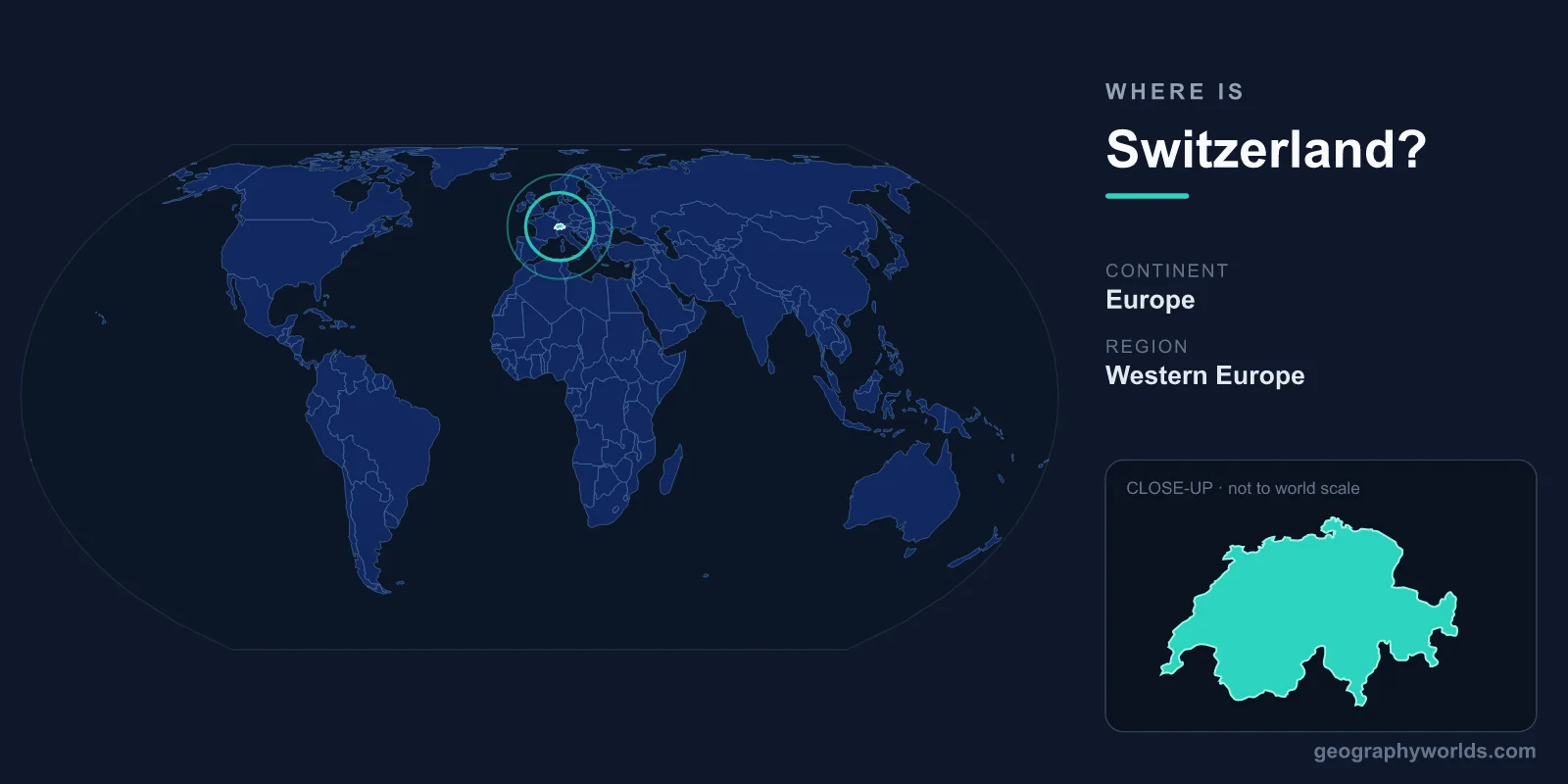
Switzerland is a landlocked country in central Europe, sitting at the heart of the Alps and bordered by five nations: Germany to the north, France to the west, Italy to the south, and Austria and Liechtenstein to the east. It lies in the Northern and Eastern Hemispheres, roughly at 47° North latitude and 8° East longitude, with its capital at Bern and a total area of about 41,285 km².
Where Exactly Is Switzerland on the Map?
Switzerland occupies the central spine of Europe, wedged between the German-speaking north and the Mediterranean south. To picture it, find the European continent and look just south of Germany, east of France, and north of Italy: that compact mountainous block is Switzerland. Because it is fully landlocked, the country has no coastline at all. The nearest seas are the Mediterranean, reached through Italy or France, and the North Sea, accessible to the north via the Rhine River.
Its position straddles two of the continent's great drainage divides. The Rhine rises in the Swiss Alps and flows north toward the North Sea, while the Rhône heads south and west toward the Mediterranean, and the Inn feeds eventually into the Danube and the Black Sea. Few countries send their waters to three different seas, a sign of just how central Switzerland's location truly is.
Which Countries Border Switzerland?
Switzerland shares land borders with five neighbours, a fact that helps explain its multilingual character and its long history as a hub for trade and diplomacy:
- Germany – to the north, largely along the Rhine and Lake Constance
- France – to the west, across the Jura range and along Lake Geneva
- Italy – to the south, over the high Alpine passes near peaks such as the Matterhorn
- Austria – to the east, through the Alps and the upper Rhine valley
- Liechtenstein – a tiny principality to the east, sitting between Switzerland and Austria
Being surrounded by the Germanic, French, and Italian worlds explains why Switzerland has four national languages and a culture that draws on all of its neighbours at once.
The Landscape: Alps, Plateau, and Jura
Geographers divide Switzerland into three broad regions. The Alps cover roughly 60% of the territory and include some of Europe's most famous peaks, among them the pyramid-shaped Matterhorn (4,478 m) near Zermatt and the Dufourspitze in the Monte Rosa massif, the country's highest point at 4,634 metres. The Swiss Plateau, or Mittelland, is the lower belt running between the Jura and the Alps; though it makes up only about a third of the land, it holds most of the population and the largest cities. The Jura Mountains form a lower, forested range along the northwestern frontier with France.
This high terrain feeds dozens of glaciers and more than 1,500 lakes. Lake Geneva and Lake Constance, both shared with neighbours, are among the largest in the region, and the Alpine watershed makes Switzerland a vital source of fresh water for much of Western Europe.
Why Switzerland's Location Matters
Because it sits astride the principal north–south passes through the Alps, Switzerland has long controlled key transit routes between Germany and Italy. Tunnels such as the Gotthard Base Tunnel, the world's longest railway tunnel at 57 kilometres, now carry much of this traffic beneath the mountains. The country's central, neutral position has also shaped its political role: Geneva hosts the United Nations' European headquarters and the International Committee of the Red Cross, making Switzerland a centre of global diplomacy despite its modest size.
The nation is organised into 26 cantons and is home to roughly 9 million people. Bern is the federal capital, while Zurich is the largest city and financial hub, and Geneva and Basel anchor the west and north. Switzerland uses the Swiss franc (CHF) and operates as a federal semi-direct democracy in which citizens vote directly on many issues. To compare its scale, the country is about the size of the Netherlands or roughly half the size of Ireland. You can explore more about its regions, culture, and travel highlights in our switzerland country guide.
Frequently Asked Questions
Is Switzerland in the European Union?
No. Switzerland lies in central Europe and is part of the Schengen Area for travel, but it is not a member of the European Union. It maintains close ties with the EU through a series of bilateral agreements while preserving its long tradition of neutrality.
What continent is Switzerland on?
Switzerland is located on the continent of Europe, in its central region, surrounded entirely by other European countries.
Does Switzerland have a coastline?
No. Switzerland is completely landlocked, bordered by five countries. Its many lakes and rivers give it abundant inland water access, and Basel even functions as a river port linked to the North Sea via the Rhine.
What is the capital of Switzerland?
Bern is the federal capital, located on the Swiss Plateau along the Aare River. Although Zurich and Geneva are larger and more internationally recognised, Bern hosts the national government and parliament.