
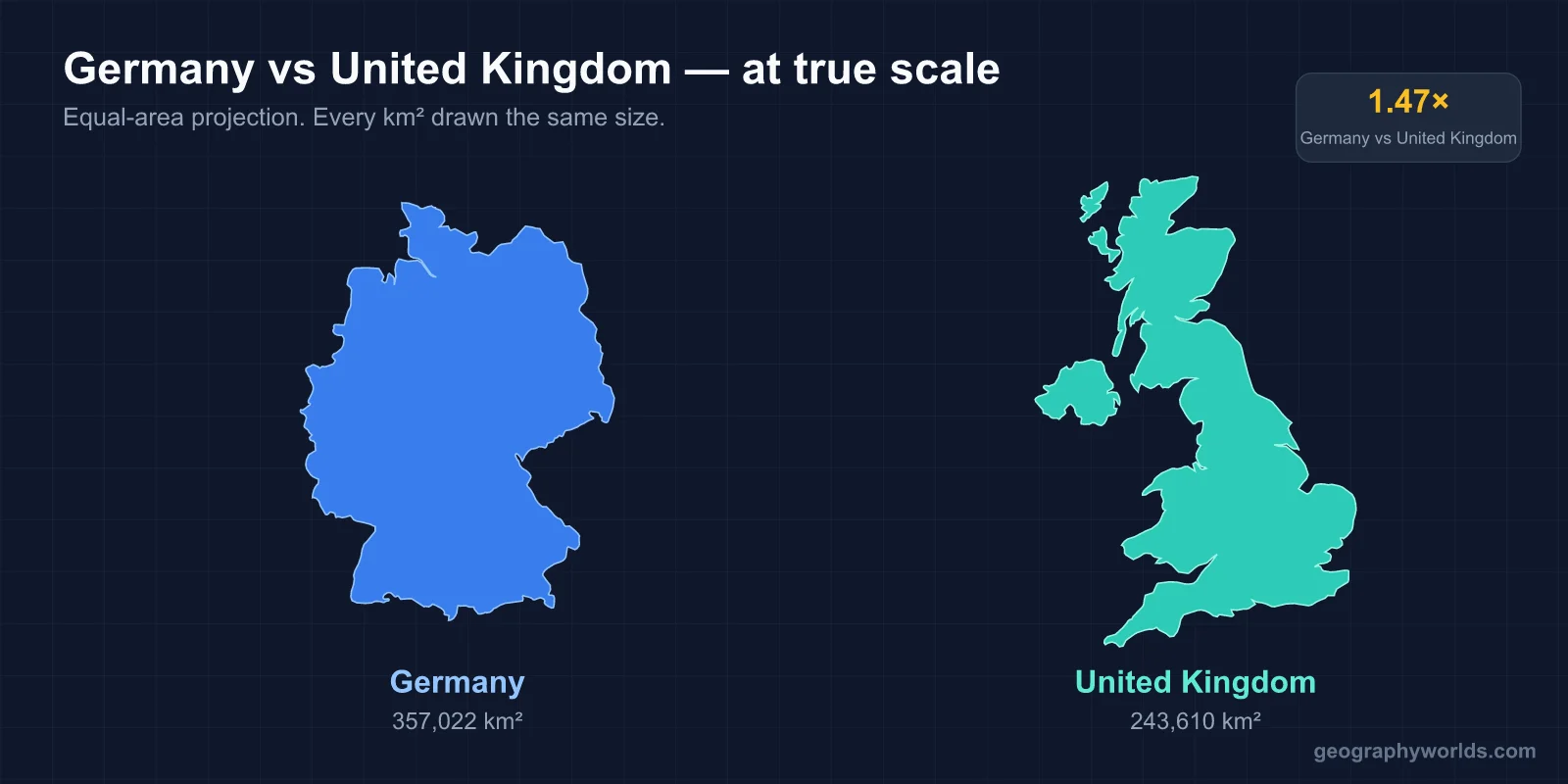
Germany is the larger and more populous of the two: it covers 357,022 km² (about 1.5 times the United Kingdom's 243,610 km²) and is home to roughly 83.6 million people, compared with the UK's 69.9 million. The UK, however, is more densely populated and is an island nation, while Germany sits at the heart of continental Europe sharing land borders with nine countries. Both are Western European economic powerhouses, but they differ sharply in geography, currency, and political structure.
How do Germany 🇩🇪 and the United Kingdom 🇬🇧 stack up side by side? Both are founding pillars of the modern European economy, yet their landscapes, climates, and national identities could hardly be more distinct. This comparison walks through size, population, capitals, language, climate, and culture so that students, travellers, and the simply curious can see exactly how these two nations differ.
Size and Geography
| Feature | Germany 🇩🇪 | United Kingdom 🇬🇧 |
|---|---|---|
| Area | 357,022 km² | 243,610 km² |
| Continent | Europe | Europe |
| Region | Western Europe | Western Europe |
| Land Borders | Denmark, Poland, Czech Republic, Austria, Switzerland, France, Luxembourg, Belgium, Netherlands | Ireland |
| Landscape | lowlands in north, central uplands, Alps in south | varied topography; highlands in north, lowlands in south and east |
The single biggest geographic difference is that Germany is a continental country while the UK is an island nation. Germany shares 3,700-plus kilometres of land borders with nine neighbours, making it Europe's most connected country by border count. The United Kingdom, by contrast, has just one land border on the island of Great Britain — none at all — with its only frontier running across the island of Ireland, where Northern Ireland meets the Republic of Ireland. Everything else is coastline, and the English Channel and North Sea have shaped British history as both a defence and a trade route for centuries.
Germany's terrain rises gradually from the flat North European Plain along the North and Baltic Seas, through the wooded central uplands, to the dramatic Bavarian Alps in the far south, where the Zugspitze reaches 2,962 metres — the country's highest point. The UK's landscape is more compact but surprisingly varied: the rugged Scottish Highlands and Snowdonia contrast with the rolling lowlands of southern and eastern England. Ben Nevis in Scotland, at 1,345 metres, is Britain's tallest peak.
Population and Demographics
| Metric | Germany 🇩🇪 | United Kingdom 🇬🇧 |
|---|---|---|
| Population | 83.6 million | 69.9 million |
| Population Density | 234.3 per km² | 287.1 per km² |
Germany has the larger population — roughly 1.2 times that of the UK — and it is the most populous country in the European Union. Yet because the United Kingdom packs nearly 70 million people into a much smaller area, it is the more crowded of the two, with about 287 people per square kilometre versus Germany's 234. That gap of roughly 53 people per km² is felt most acutely in southeast England, where London and its commuter belt form one of Europe's densest urban regions.
Both countries are highly urbanised and have experienced significant immigration in recent decades, giving their major cities a multicultural character. Germany's population is spread across several large cities of comparable size — Berlin, Hamburg, Munich, Cologne and Frankfurt — whereas the UK is far more dominated by a single metropolis, London, which dwarfs the next-largest cities of Birmingham and Manchester.
Capital Cities
Berlin is the capital of Germany, while London is the capital of the United Kingdom. The two cities illustrate the broader differences between the nations. Berlin, with around 3.7 million residents, is a city famously reshaped by 20th-century history — divided by the Berlin Wall from 1961 to 1989 and reunified as the capital of a single Germany. It is the seat of the Bundestag (federal parliament) and the largest city in the EU.
London, home to roughly 9 million people, is one of the world's leading financial centres and the seat of the UK Parliament at Westminster. Unlike Berlin, which shares political and economic influence with Frankfurt (Germany's financial hub) and Munich, London concentrates an outsized share of the UK's wealth, government and culture in one place.
Language, Currency and Government
| Aspect | Germany 🇩🇪 | United Kingdom 🇬🇧 |
|---|---|---|
| Languages | German (official) | English (official), Welsh, Scottish Gaelic, Irish |
| Currency | Euro (EUR) | British Pound Sterling (GBP) |
| Government | Federal parliamentary republic | Constitutional monarchy |
Two of the clearest dividing lines between these nations are currency and political structure. Germany adopted the euro in 2002 and is the largest economy in the eurozone. The United Kingdom kept the pound sterling — one of the world's oldest currencies still in use — and in 2020 it formally left the European Union following the 2016 Brexit referendum, ending a relationship that had begun in 1973.
Germany is a federal parliamentary republic made up of 16 states (Bundesländer), each with considerable autonomy, and its head of state is a president. The UK is a constitutional monarchy with a hereditary monarch as head of state and a long-standing system of devolved governments in Scotland, Wales and Northern Ireland. English is the dominant language across both the UK and as a global lingua franca, while German is spoken by more than 90 million people across Central Europe.
Climate and Natural Features
| Aspect | Germany 🇩🇪 | United Kingdom 🇬🇧 |
|---|---|---|
| Climate | temperate; cool, wet winters and mild summers | temperate maritime; mild, wet year-round |
| Key Features | Black Forest, Rhine River, Bavarian Alps, North Sea coast | Scottish Highlands, Lake District, White Cliffs of Dover, Thames River |
| Economy | automotive, engineering, chemicals, technology | finance, services, pharmaceuticals, aerospace, creative industries |
Because both nations sit at similar latitudes and are influenced by the North Atlantic, their climates are broadly temperate, but the UK's island position gives it a milder, wetter maritime climate with less seasonal extremes. Germany's continental influence means colder winters inland and warmer summers, especially in the south and east, far from the moderating sea.
Germany's signature landscapes include the Rhine River — one of Europe's great waterways and trade arteries — the dense Black Forest, and the alpine peaks of Bavaria. The United Kingdom is defined by the wild Scottish Highlands, the lakes and fells of the Lake District, the iconic White Cliffs of Dover, and the River Thames flowing through London. Economically, Germany is the world's leading exporter of cars and machinery, while the UK leans heavily on financial services, pharmaceuticals, aerospace and globally influential creative industries.
What Makes Each Country Unique
Germany is internationally renowned for automotive engineering (BMW, Mercedes-Benz, Volkswagen, Porsche, Audi), Oktoberfest, fairytale castles such as Neuschwanstein, and a rich tradition of classical music and philosophy. It is also famous for beer, with over 1,500 distinct varieties and more than 1,300 breweries, plus a centuries-old purity law (Reinheitsgebot) governing how it is brewed.
The United Kingdom is best known for the Royal Family, the Palace of Westminster and Big Ben, the works of Shakespeare, the Premier League, and an unmatched musical legacy that runs from the Beatles to the Rolling Stones. The British Empire was the largest empire in history, at its peak covering about a quarter of the world's land area — which is why English is spoken across so much of the globe today.
Key Facts
- Larger by area: Germany (357,022 km²), about 1.5x the UK (243,610 km²)
- Larger by population: Germany (83.6 million) vs UK (69.9 million)
- More densely populated: United Kingdom (287.1 vs 234.3 people per km²)
- Capitals: Berlin vs London
- Currencies: Euro (EUR) vs Pound Sterling (GBP)
- Government: Federal parliamentary republic vs constitutional monarchy
- Geography type: Continental (9 land neighbours) vs island nation
Verdict
Germany and the United Kingdom are both heavyweight European economies, yet they sit on opposite sides of several key divides. Germany is larger, more populous, deeply connected by land to its nine neighbours, and anchored in the eurozone. The UK is a more compact, more densely settled island nation that retains its own currency and, since Brexit, charts a course outside the European Union.
Geographically, Germany ranges from North Sea lowlands to alpine peaks, while the UK packs Highlands, lakes and famous coastlines into a smaller frame. Economically, Germany leads with manufacturing and engineering, while the UK is powered by finance and services. For students and travellers alike, understanding these contrasts builds a much richer picture of two of Europe's most influential countries.
Frequently Asked Questions
Is Germany bigger than the United Kingdom?
Yes. Germany covers 357,022 km², roughly 1.5 times the United Kingdom's 243,610 km². Germany is also more populous, with about 83.6 million people compared with the UK's 69.9 million.
Which country has a higher population density?
The United Kingdom is more densely populated, with around 287 people per square kilometre compared with Germany's 234. Although Germany has more people overall, it spreads them across a larger land area.
What currencies do Germany and the UK use?
Germany uses the euro (EUR), which it adopted in 2002 as a member of the eurozone. The United Kingdom uses the British pound sterling (GBP) and never joined the euro; it also left the European Union in 2020.
Do Germany and the United Kingdom share a border?
No. They do not share a land border. The UK is an island nation whose only land frontier is between Northern Ireland and the Republic of Ireland. Germany, by contrast, borders nine countries on the European mainland.
Test Your Knowledge!
Think you know your countries? Try our interactive geography quiz!
Play Geography Games →