
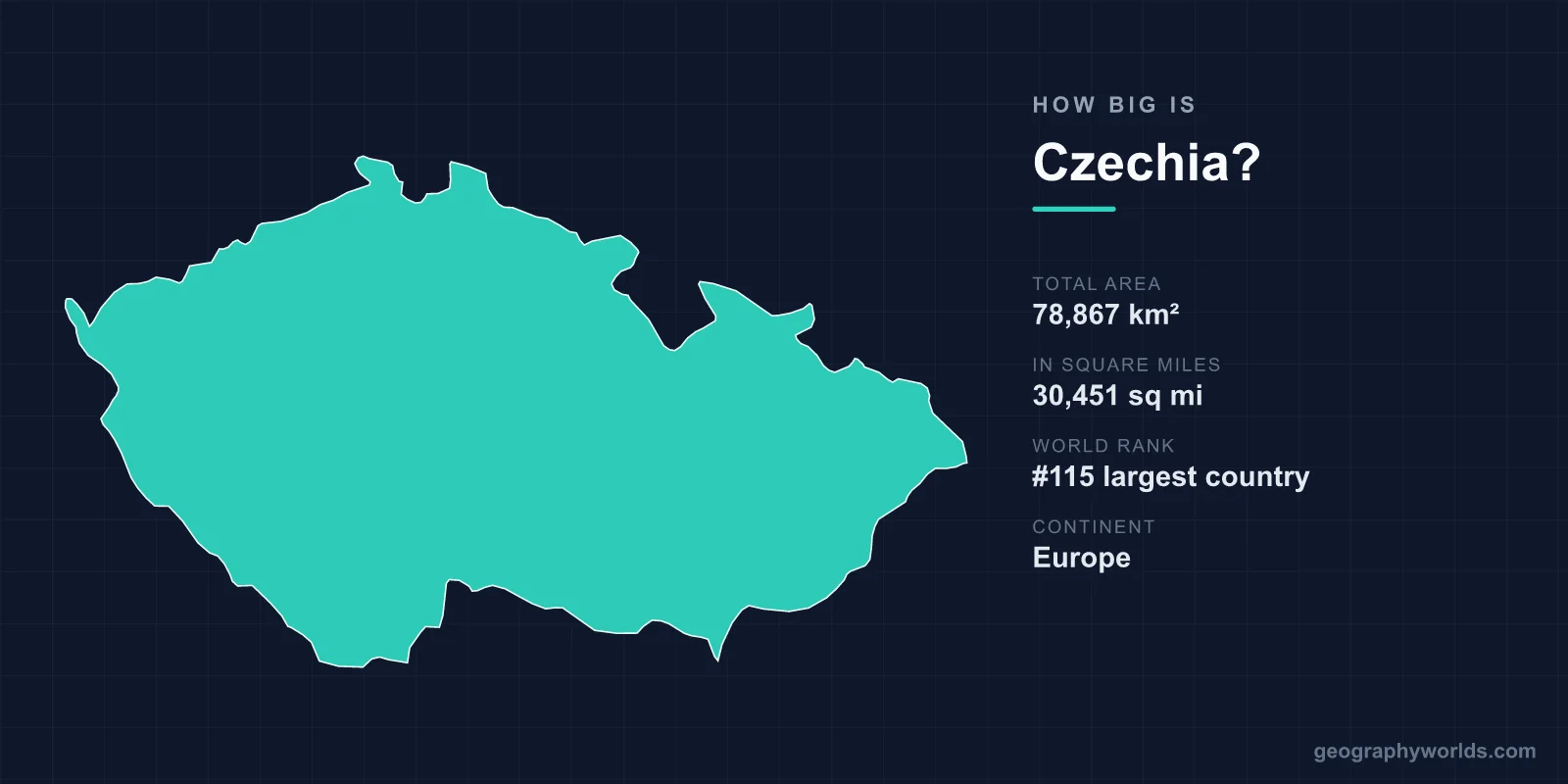
The Czech Republic covers a total area of 78,867 km² (30,451 sq mi), making it the 115th largest country in the world — roughly the size of the U.S. state of South Carolina or about a fifth larger than Ireland. Though modest in scale, this landlocked nation packs a remarkable variety of mountains, river basins, and historic landscapes into its compact borders at the very center of Europe.
The Numbers Behind the Czech Republic's Size
At 78,867 km², the Czech Republic accounts for only about 0.05% of Earth's total land area of roughly 149 million km². That places it firmly among Europe's mid-sized states — larger than Austria or Ireland, but considerably smaller than neighbouring Germany or Poland. Despite its small footprint, the country is home to a population of around 10.5 million people, giving it a relatively dense population for Central Europe.
- Total area: 78,867 km² (30,451 sq mi)
- World rank: 115th largest country
- Share of global land: approximately 0.05%
- Continent: Europe (Central Europe)
- Capital: Prague
- Coastline: none — fully landlocked
Dimensions and Borders
The Czech Republic stretches about 493 km from west to east but only around 278 km from north to south, giving it a distinctly elongated shape. It shares land borders with four countries: Germany to the west and northwest, Poland to the north and northeast, Slovakia to the southeast, and Austria to the south. Together these borders run for roughly 2,140 km, and because the country has no sea access, every kilometre of its perimeter touches another nation.
This central position is why the Czech Republic is often called the "heart of Europe." Prague sits almost exactly between Berlin, Vienna, and Warsaw, and historically the Czech lands have served as a crossroads where Germanic, Slavic, and Latin cultural currents met.
Terrain: A Natural Fortress
One reason the Czech Republic feels larger than its area suggests is its varied, ring-like topography. The country is essentially a basin surrounded on nearly every side by low mountain ranges that act as a natural rampart. The Krušné hory (Ore Mountains) line the northwest, the Sudetes rise along the northern border with Poland, and the Bohemian-Moravian Highlands divide the two historic regions of Bohemia and Moravia in the centre. The Moravian lowlands open up toward the southeast.
The highest point is Sněžka at 1,603 m (5,259 ft), located in the Krkonoše (Giant Mountains) on the Polish frontier. The lowest point lies where the Elbe River exits toward Germany, at roughly 115 m above sea level. Two major rivers define the Czech landscape: the Vltava, which flows through Prague, and the Elbe (Labe), which carries Czech waters northward to the North Sea via Germany — a reminder that even a landlocked country can be connected to the ocean by its rivers.
How the Czech Republic Compares
Size becomes clearer through comparison. The Czech Republic is almost exactly the same area as South Carolina and a touch larger than the island of Ireland. Measured against its neighbours and peers:
- About 32% the size of the United Kingdom (243,610 km²).
- About 79% the size of South Korea (100,210 km²).
- Roughly 22% the size of neighbouring Germany (357,000 km²).
- Slightly larger than Austria (83,879 km²) when measured against most European states — though Austria edges it out by a small margin.
For a fuller picture of the nation's regions, climate, and culture, see our czech republic country guide.
Landscapes Packed Into a Small Country
The Czech Republic's temperate continental climate brings warm summers (often 20–25°C) and cold winters (around -2 to -4°C), with the mountains receiving the most rainfall. Within its borders are some surprisingly dramatic landscapes for such a compact territory. The Bohemian Paradise is a sandstone "rock city" of towers and pinnacles, while the Moravian Karst contains the Macocha Abyss, the deepest sinkhole in Central Europe at 138 m. Bohemian Switzerland National Park in the north shelters the largest natural sandstone arch in Europe.
Human-made landmarks are just as dense. The country holds over 2,000 castles and châteaux — one of the highest concentrations anywhere — crowned by Prague Castle, often cited as the largest ancient castle complex in the world.
Frequently Asked Questions
Is the Czech Republic a small country?
It is a mid-sized European country and the 115th largest in the world. By global standards it is on the smaller side, but within Europe it is larger than Austria, Ireland, or Switzerland.
What U.S. state is the Czech Republic the size of?
The Czech Republic is almost exactly the same size as South Carolina, which covers about 82,900 km². It is also comparable to a combination of Maine, or slightly larger than the state of Maine on its own.
Does the Czech Republic have a coastline?
No. The Czech Republic is completely landlocked, bordered by Germany, Poland, Slovakia, and Austria. Its rivers, however, connect it to the sea — the Elbe flows to the North Sea and the Morava feeds the Danube toward the Black Sea.
What is the highest point in the Czech Republic?
Sněžka, at 1,603 m (5,259 ft), in the Giant Mountains on the border with Poland, is the country's highest peak.