
Introduction
How do India 🇮🇳 and China 🇨🇳 compare? The two most populous nations on Earth. In this geographic comparison, we examine how these two nations stack up across size, population, capitals, natural features, and more.
Whether you're studying geography, planning travel, or simply curious about how countries differ, this side-by-side comparison of India and China provides the key facts and figures you need.
Size & Geography
| Feature | India 🇮🇳 | China 🇨🇳 |
|---|---|---|
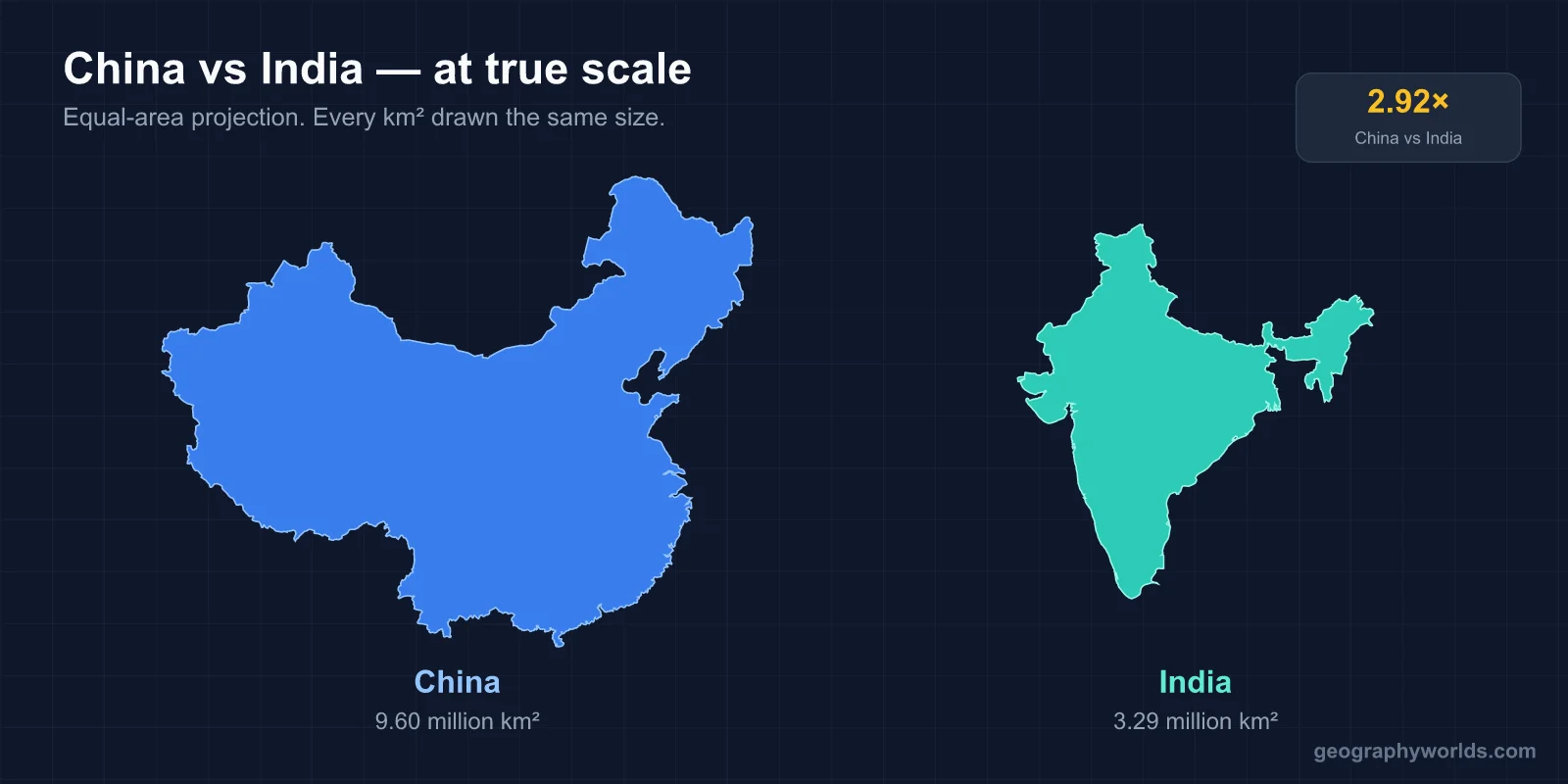
| Area | 3,287,263 km² | 9,596,961 km² |
| Continent | Asia | Asia |
| Region | South Asia | East Asia |
| Land Borders | Pakistan, China, Nepal, Bhutan, Bangladesh, Myanmar | Russia, Mongolia, Kazakhstan, Kyrgyzstan, Tajikistan, Afghanistan, Pakistan, India, Nepal, Bhutan, Myanmar, Laos, Vietnam, North Korea |
| Landscape | Himalayan mountains, Indo-Gangetic plain, Deccan Plateau, coastal regions | mountains, plateaus, deserts, and river basins |
China is approximately 2.9 times larger in area than India. India features Himalayan mountains, Indo-Gangetic plain, Deccan Plateau, coastal regions, while China is characterized by mountains, plateaus, deserts, and river basins.
Population & Demographics
| Metric | India 🇮🇳 | China 🇨🇳 |
|---|---|---|
| Population | 1.48 billion | 1.41 billion |
| Population Density | 449.2 per km² | 147.2 per km² |
India has a larger population, approximately 1.0 times that of China. In terms of population density, India is more densely populated, with a difference of about 302.0 people per km².
Capital Cities
New Delhi serves as the capital of India, while Beijing is the capital of China. Both capitals are located in Asia, with New Delhi in South Asia and Beijing in East Asia.
Language, Currency & Culture
| Aspect | India 🇮🇳 | China 🇨🇳 |
|---|---|---|
| Languages | Hindi and English (official), plus 21 other scheduled languages | Mandarin Chinese (official), Cantonese, Wu, Min, and many regional languages |
| Currency | Indian Rupee (INR) | Chinese Yuan Renminbi (CNY) |
In India, Hindi and English (official) is widely spoken, while China uses Mandarin Chinese (official). These linguistic differences reflect each country's unique colonial history, indigenous heritage, and cultural evolution over centuries.
Climate & Natural Features
| Aspect | India 🇮🇳 | China 🇨🇳 |
|---|---|---|
| Climate | varies from tropical monsoon to alpine in the north | extremely diverse; tropical to subarctic |
| Key Features | Himalayas, Ganges River, Thar Desert, Western Ghats | Himalayas, Yangtze River, Gobi Desert, Tibetan Plateau |
| Economy | IT services, agriculture, manufacturing, pharmaceuticals | manufacturing, technology, agriculture, exports |
India has a varies from tropical monsoon to alpine in the north climate, featuring notable landmarks such as Himalayas, Ganges River, Thar Desert, Western Ghats. Meanwhile, China experiences a extremely diverse; tropical to subarctic climate and is known for Himalayas, Yangtze River, Gobi Desert, Tibetan Plateau.
What Makes Each Country Unique
India is internationally renowned for the Taj Mahal, Bollywood cinema, diverse cuisine, and being the world's largest democracy. India has 22 officially recognized languages and over 19,500 dialects, making it one of the most linguistically diverse countries.
China is best known for the Great Wall, ancient civilization, Forbidden City, and being the world's manufacturing hub. China's Great Wall stretches over 21,000 km — if fully straightened, it would span more than half the circumference of the Earth.
Key Differences at a Glance
- Area: India (3,287,263 km²) vs China (9,596,961 km²) — China is 2.9x larger
- Population: India (1.48 billion) vs China (1.41 billion) — India is 1.0x more populous
- Capitals: New Delhi vs Beijing
- Currency: Indian Rupee (INR) vs Chinese Yuan Renminbi (CNY)
- Continents: Asia vs Asia
- Density: India is more densely populated (difference of ~302.0 people per km²)
- Languages: Hindi and English (official) vs Mandarin Chinese (official)
Verdict
India and China — the two most populous nations on earth — each offer unique geographic characteristics that make them fascinating to compare. While China claims the larger land area (2.9x), India leads in population (1.0x), showing how size and population don't always go hand in hand.
India stands out for its varies from tropical monsoon to alpine in the north climate and landmarks like Himalayas, whereas China is defined by its extremely diverse; tropical to subarctic climate and features such as Himalayas. Economically, India focuses on IT services while China drives growth through manufacturing.
Both nations contribute uniquely to our world's geographic tapestry. Whether you're planning a visit, studying world geography, or simply satisfying your curiosity, understanding these differences helps build a richer picture of our diverse planet.
Test Your Knowledge!
Think you know your countries? Try our interactive geography quiz!
Play Geography Games →