
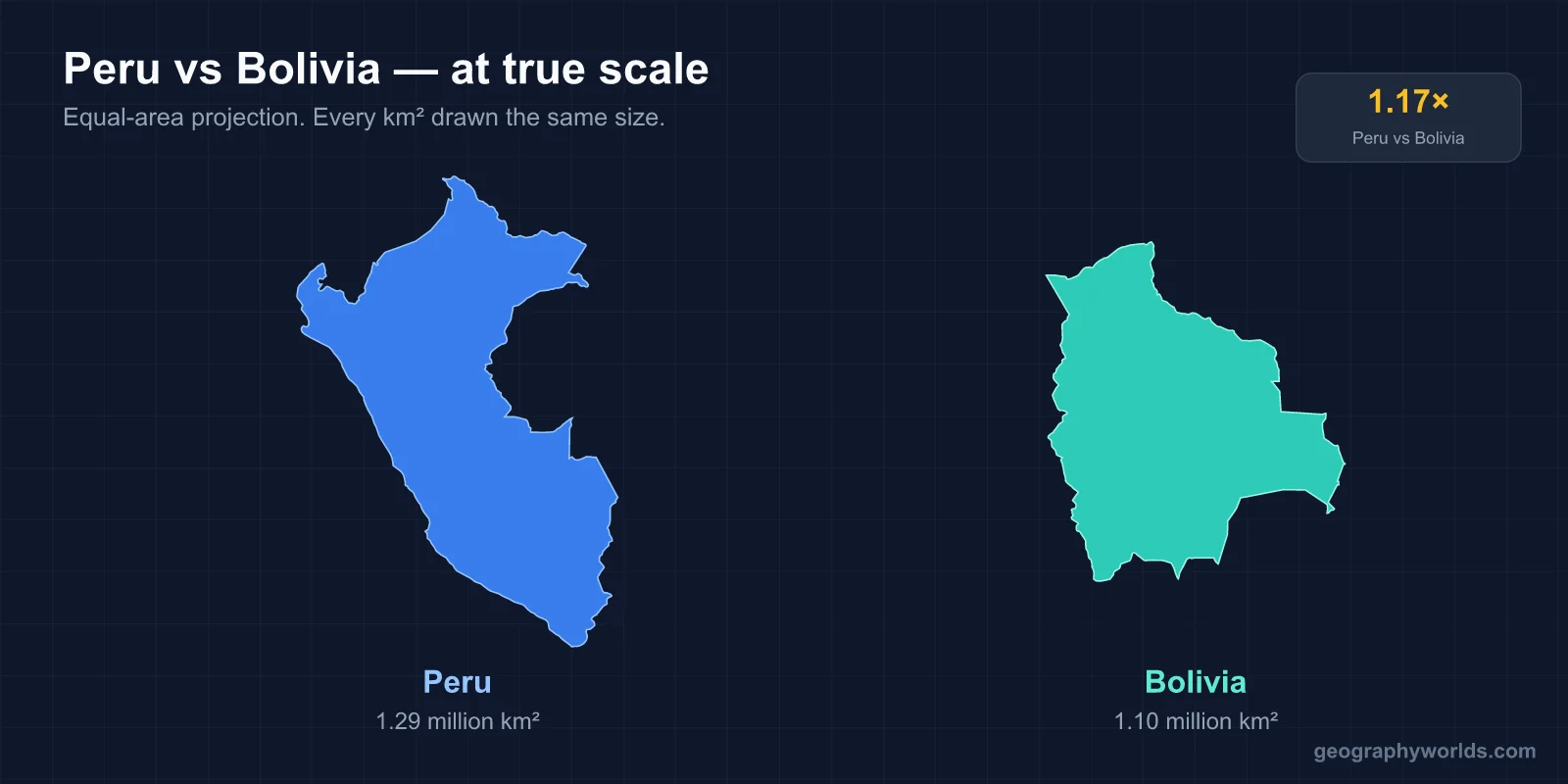
Peru and Bolivia are neighboring Andean nations, but they differ sharply in scale and geography: Peru covers about 1,285,216 km² with roughly 34.9 million people and a Pacific coastline, while landlocked Bolivia covers 1,098,581 km² with about 12.7 million people. Peru is around 1.2 times larger in area and 2.7 times more populous, yet both share the high Andes, a slice of the Amazon basin, and the shores of Lake Titicaca.
These two countries are often mentioned in the same breath, and for good reason. They share a long border, a deep Inca and pre-Inca heritage, three major languages, and the world's highest navigable lake. But a closer look reveals two distinct geographies, economies, and identities. Whether you are studying for a quiz, planning a trip across the altiplano, or simply curious, this side-by-side comparison covers the facts that matter.
Size & Geography
| Feature | Peru 🇵🇪 | Bolivia 🇧🇴 |
|---|---|---|
| Area | 1,285,216 km² | 1,098,581 km² |
| Continent | South America | South America |
| Coastline | ~2,400 km of Pacific coast | Landlocked (no coastline) |
| Land Borders | Ecuador, Colombia, Brazil, Bolivia, Chile | Brazil, Paraguay, Argentina, Chile, Peru |
| Landscape | Andes mountains, Amazon basin, coastal desert | Andes mountains, Altiplano plateau, tropical lowlands |
Peru is roughly 1.2 times larger than Bolivia, but the single most important geographic difference is access to the sea. Peru is a maritime nation with about 2,400 kilometers of Pacific coastline, including the major port of Callao near Lima. Bolivia is landlocked, a status it has held since losing its coastal Litoral province to Chile in the War of the Pacific (1879–1884) — a loss the country still commemorates and disputes diplomatically.
Both countries are split by the towering Andes. Peru's terrain falls into three classic zones: the arid Pacific costa, the mountainous sierra, and the Amazonian selva to the east. Bolivia centers on the vast high-altitude Altiplano, a windswept plateau sitting around 3,800 meters, that descends into tropical lowlands toward Brazil and Paraguay.
Population & Demographics
| Metric | Peru 🇵🇪 | Bolivia 🇧🇴 |
|---|---|---|
| Population | 34.9 million | 12.7 million |
| Population Density | 27.2 per km² | 11.6 per km² |
| Largest City | Lima (~10 million metro) | Santa Cruz de la Sierra |
Peru's population is about 2.7 times larger than Bolivia's, and it is also more than twice as densely settled. A huge share of Peruvians live along the central coast, where greater Lima alone holds close to a third of the national population. Bolivia's people are concentrated on the Altiplano around La Paz and El Alto, and increasingly in the booming tropical lowland city of Santa Cruz de la Sierra.
Both nations have large Indigenous populations — among the highest proportions in the Americas. Quechua and Aymara peoples are central to the identity of each country, and that heritage is woven through language, dress, food, and politics in both Peru and Bolivia.
Capital Cities
This is where many comparisons get it wrong. Lima is unambiguously Peru's capital and largest city, home to the national government and roughly 10 million people in its metropolitan area. Bolivia, however, has two capitals. Sucre is the constitutional and judicial capital and the historic founding city, while La Paz is the seat of the executive and legislative branches — making it the de facto administrative capital and the highest capital city in the world at about 3,640 meters above sea level. If a quiz asks for "the capital of Bolivia," Sucre is the technically correct answer, but La Paz is where the government actually sits.
Language, Currency & Culture
| Aspect | Peru 🇵🇪 | Bolivia 🇧🇴 |
|---|---|---|
| Languages | Spanish (official), Quechua, Aymara | Spanish, Quechua, Aymara + dozens of recognized Indigenous languages |
| Currency | Peruvian Sol (PEN) | Bolivian Boliviano (BOB) |
Spanish is the dominant language in both countries, but each constitutionally recognizes Indigenous languages too. Peru gives official status to Spanish, Quechua, and Aymara (and other Indigenous tongues where they predominate). Bolivia goes furthest of any country in the Americas, recognizing Spanish alongside 36 Indigenous languages in its 2009 constitution, reflecting its self-definition as a "plurinational" state.
Culturally, the two share Andean roots but express them differently. Peruvian cuisine — ceviche, lomo saltado, and a globally celebrated culinary scene — is a point of national pride. Bolivia's culture is more closely tied to the Altiplano, with festivals like Oruro's Carnival (a UNESCO-recognized event) and a strong continuing presence of traditional Aymara and Quechua life.
Climate & Natural Features
| Aspect | Peru 🇵🇪 | Bolivia 🇧🇴 |
|---|---|---|
| Climate | Tropical in the east, dry desert in the west | Tropical in the east, cold semiarid on the Altiplano |
| Key Features | Machu Picchu, Andes, Amazon, Lake Titicaca, Nazca Lines | Salar de Uyuni, Lake Titicaca, Andes, Amazon basin |
| Economy | Mining (copper, gold), agriculture, fishing, textiles | Mining (lithium, tin), natural gas, agriculture |
Peru's climate ranges from the rainless coastal desert in the west — one of the driest places on Earth — to humid Amazon rainforest in the east, with cool, dry highlands in between. Bolivia trades the ocean-cooled desert for a cold, thin-aired semiarid Altiplano, while its eastern lowlands share the same tropical character as Peru's selva.
The two countries famously share Lake Titicaca, the highest navigable lake in the world, which straddles their border at about 3,810 meters. Beyond that, each has a signature wonder: Peru has Machu Picchu and the Nazca Lines, while Bolivia has the Salar de Uyuni, the world's largest salt flat, so flat and reflective that it is used to calibrate satellite altimeters and turns into a giant mirror in the rainy season.
Economically, both rely heavily on mining, but with a forward-looking twist: Bolivia sits on some of the planet's largest lithium reserves beneath the Uyuni salt flats, positioning it as a potential player in the global battery economy, while Peru is one of the world's top copper and silver producers.
What Makes Each Country Unique
Peru is internationally renowned for Machu Picchu, the heart of the former Inca Empire, along with its world-class cuisine and the cultural depth of Cusco, the ancient Inca capital. Machu Picchu was hidden from wider knowledge for centuries before it was brought to international attention in 1911.
Bolivia is defined by altitude and the Altiplano. It holds the world's highest administrative capital (La Paz), the world's largest salt flat (Salar de Uyuni), and its share of the highest navigable lake. Its 2009 reinvention as the "Plurinational State of Bolivia" also makes it one of the most explicitly multicultural constitutions on the planet.
Key Facts
- Area: Peru 1,285,216 km² vs Bolivia 1,098,581 km² (Peru ~1.2x larger)
- Population: Peru 34.9 million vs Bolivia 12.7 million (Peru ~2.7x more populous)
- Capital: Lima (Peru) vs Sucre, with La Paz as seat of government (Bolivia)
- Sea access: Peru has a Pacific coast; Bolivia is landlocked
- Currency: Peruvian Sol (PEN) vs Bolivian Boliviano (BOB)
- Shared feature: Lake Titicaca, the world's highest navigable lake, lies on their border
- Signature site: Machu Picchu (Peru) vs Salar de Uyuni (Bolivia)
Verdict
Peru and Bolivia are high Andean neighbors that share a heritage and a lake but lead very different lives. Peru is the larger, more populous, ocean-facing nation, defined by Machu Picchu, a celebrated cuisine, and a powerhouse mining and fishing economy. Bolivia is the smaller, landlocked highland republic, defined by the Altiplano, the dazzling Salar de Uyuni, the world's highest capital, and a uniquely plurinational identity. Neither is simply "bigger" or "better" — they are two complementary windows into the soul of the Andes. To dig deeper into either nation, explore our flag of Bolivia guide or learn how their neighbor compares in our coverage of the flag of Chile.
Frequently Asked Questions
Is Peru bigger than Bolivia?
Yes. Peru covers about 1,285,216 km², roughly 1.2 times the area of Bolivia's 1,098,581 km². Peru is also far more populous, with around 34.9 million people compared to Bolivia's 12.7 million.
What is the capital of Bolivia, Sucre or La Paz?
Both, in different senses. Sucre is the constitutional and judicial capital and is often given as the official answer. La Paz is the seat of the executive and legislative government, making it the highest administrative capital in the world. Peru, by contrast, has a single capital: Lima.
Do Peru and Bolivia share Lake Titicaca?
Yes. Lake Titicaca, the highest navigable lake in the world at about 3,810 meters, sits on the border between the two countries. Roughly the western portion belongs to Peru and the eastern portion to Bolivia.
Which country has access to the ocean?
Only Peru. It has a long Pacific coastline with major ports such as Callao. Bolivia is landlocked and lost its coastal territory to Chile in the War of the Pacific in the late 1800s, a dispute that still shapes its diplomacy today.
Test Your Knowledge!
Think you know your countries? Try our interactive geography quiz!
Play Geography Games →