
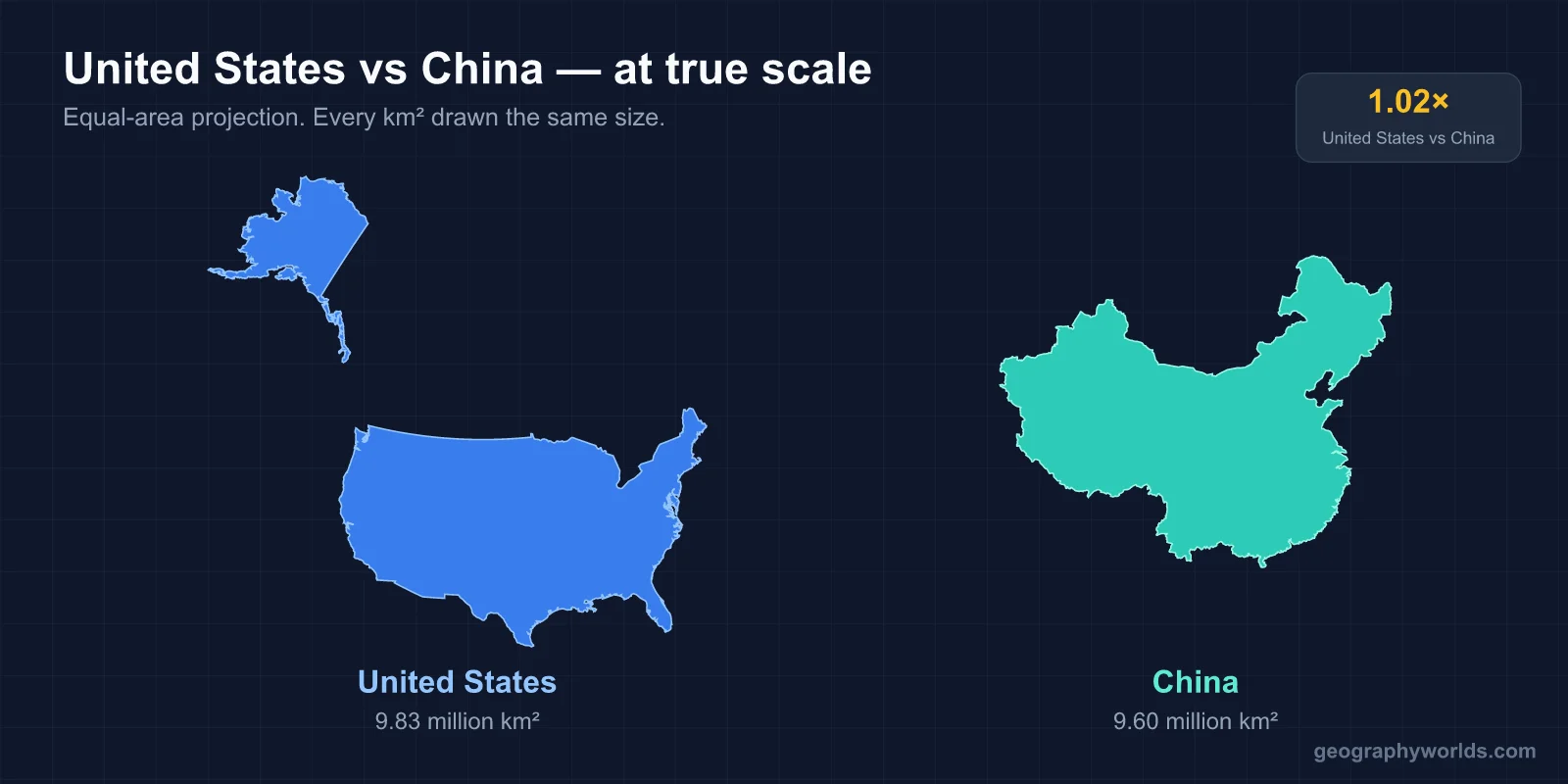
The United States and China are the world's two largest economies and two of its three largest countries by area, yet they could hardly be more different. The United States covers about 9,833,517 km² with roughly 349 million people, while China spans 9,596,961 km² but holds around 1.41 billion people — roughly four times the U.S. population on slightly less land.
This makes them a fascinating study in contrasts: similar physical scale, radically different human geography. One is a relatively young federal republic in North America; the other is an ancient East Asian civilization with thousands of years of recorded history. Below, we compare them across size, population, geography, climate, capitals, language, and the natural and cultural features that define each nation.
Size and Geography
| Feature | United States 🇺🇸 | China 🇨🇳 |
|---|---|---|
| Area | 9,833,517 km² | 9,596,961 km² |
| Continent | North America | Asia |
| Region | North America | East Asia |
| Land Borders | Canada, Mexico | Russia, Mongolia, Kazakhstan, Kyrgyzstan, Tajikistan, Afghanistan, Pakistan, India, Nepal, Bhutan, Myanmar, Laos, Vietnam, North Korea |
| Landscape | vast central plain, mountains in west, hills in east | mountains, plateaus, deserts, and river basins |
In raw land area the two countries are remarkably close — the United States is only about 2-3% larger, depending on whether disputed and coastal waters are counted. Yet their borders tell very different stories. The United States shares land frontiers with just two neighbours, Canada to the north and Mexico to the south. China, by contrast, borders fourteen countries, more than almost any other nation on Earth, stretching from the forests of the Russian Far East to the high passes of the Himalayas.
The physical layout also differs. The United States is organised around a huge central lowland — the Great Plains and Mississippi basin — flanked by the Appalachian hills in the east and the Rocky Mountains in the west. China's terrain steps down dramatically from west to east: from the towering Tibetan Plateau and Himalayas, through arid plateaus and basins, to the fertile coastal plains where most of its population lives.
Population and Demographics
| Metric | United States 🇺🇸 | China 🇨🇳 |
|---|---|---|
| Population | 349.0 million | 1.41 billion |
| Population Density | 35.5 per km² | 147.2 per km² |
This is where the two giants diverge most sharply. China's population of roughly 1.41 billion is about four times that of the United States, packed into a comparable land area, giving it more than four times the population density. But China's people are far from evenly spread. A famous demographic boundary — the Heihe–Tengchong line — divides the country roughly in half: the eastern portion holds about 94% of the population, while the vast western interior of deserts and mountains is sparsely settled.
The United States is similarly uneven, with dense coastal and urban corridors and a thinly populated interior West, but its overall density of around 36 people per km² remains low for a major economy. Demographically, both nations are now confronting ageing populations, though China's shift has been faster and sharper, partly a legacy of its former one-child policy.
Capital Cities
Washington, D.C. is the capital of the United States, a purpose-built federal district on the East Coast created specifically to serve as the seat of government. Beijing is the capital of China, a city of more than 20 million people that has served as an imperial and political centre for over 800 years. Washington, D.C. sits in North America, while Beijing lies in northern China in East Asia. Both are centres of national government rather than their country's largest commercial hubs — that distinction belongs to New York City in the U.S. and Shanghai in China.
Language, Currency and Culture
| Aspect | United States 🇺🇸 | China 🇨🇳 |
|---|---|---|
| Languages | English (de facto), Spanish widely spoken | Mandarin Chinese (official), Cantonese, Wu, Min, and many regional languages |
| Currency | United States Dollar (USD) | Chinese Yuan Renminbi (CNY) |
English is the de facto national language of the United States, though there is no official language at the federal level, and Spanish is spoken by tens of millions of residents. China's official standard language is Mandarin (Putonghua), but the country is home to a rich tapestry of regional varieties such as Cantonese, Wu (around Shanghai), and Min, alongside dozens of minority languages. The U.S. dollar functions as the world's primary reserve currency, while China's yuan renminbi is increasingly used in international trade as the country's economic clout grows.
Climate and Natural Features
| Aspect | United States 🇺🇸 | China 🇨🇳 |
|---|---|---|
| Climate | mostly temperate; tropical in Hawaii and Florida; arctic in Alaska | extremely diverse; tropical to subarctic |
| Key Features | Grand Canyon, Great Lakes, Rocky Mountains, Mississippi River | Himalayas, Yangtze River, Gobi Desert, Tibetan Plateau |
| Economy | technology, finance, healthcare, military, agriculture | manufacturing, technology, agriculture, exports |
Both countries are large enough to contain almost every climate zone on the planet. The continental United States is mostly temperate, with humid subtropical conditions in the southeast, arid deserts in the southwest, a Mediterranean climate in California, tropical Hawaii, and Arctic Alaska. China is equally varied, ranging from tropical Hainan island in the south to subarctic conditions in the northeast, with vast deserts like the Gobi and the cold, thin air of the Tibetan Plateau.
Their signature natural landmarks reflect this diversity. The United States is defined by the Grand Canyon, the five Great Lakes, the Rocky Mountains, and the mighty Mississippi River. China's landscape is shaped by the Himalayas — home to the highest peaks on Earth — the Yangtze, Asia's longest river, the Gobi Desert, and the high Tibetan Plateau, often called the "roof of the world."
What Makes Each Country Unique
The United States is internationally renowned for Hollywood, Silicon Valley, its sprawling national park system, the Statue of Liberty, and outsized cultural influence worldwide. A striking geographic quirk: the U.S. experiences more tornadoes than any other country, averaging around 1,200 per year, concentrated in the central "Tornado Alley." For a deeper profile of the country's geography and history, see our United States country guide.
China is best known for the Great Wall, one of the longest human-made structures ever built, along with its ancient civilization, the Forbidden City, and its role as the world's manufacturing hub. The Great Wall stretches over 21,000 km in total — if straightened, it would span more than half the circumference of the Earth. Explore more in our China country guide.
Key Facts
- Area: United States 9,833,517 km² vs China 9,596,961 km² (U.S. ~2-3% larger)
- Population: United States 349.0 million vs China 1.41 billion (China ~4x larger)
- Population density: United States 35.5/km² vs China 147.2/km²
- Capitals: Washington, D.C. vs Beijing
- Currency: US Dollar (USD) vs Chinese Yuan Renminbi (CNY)
- Land neighbours: United States 2 vs China 14
- Continents: North America vs Asia (East Asia)
Verdict
The United States and China are near-twins in land area yet opposites in nearly everything else. China leads dramatically in population while the United States holds a slim edge in size, proving that area and population rarely move together. The U.S. is shaped by its temperate heartland, abundant coastlines, and just two neighbours; China is defined by extreme geographic diversity, fourteen land borders, and a population concentrated along its fertile eastern seaboard.
Economically, the United States is anchored in technology, finance, and services, while China rose to global prominence through manufacturing and exports before expanding into high technology of its own. Together these two nations dominate the 21st-century world economy, making the contrast between them one of the most consequential comparisons in modern geography.
Test Your Knowledge!
Think you know your countries? Try our interactive geography quiz!
Play Geography Games →Frequently Asked Questions
Is the United States bigger than China?
By total area, yes — but only slightly. The United States covers about 9,833,517 km² compared with China's 9,596,961 km², making the U.S. roughly 2-3% larger. The exact ranking depends on how coastal and disputed territories are counted, but the two are very close in size.
Why does China have so many more people than the United States?
China's population of around 1.41 billion is about four times the U.S. total of roughly 349 million, despite a similar land area. This reflects thousands of years of dense agricultural settlement along China's fertile river valleys and eastern plains, whereas the United States is a younger nation with a far lower overall population density of about 36 people per km².
How many countries border China and the United States?
The United States shares land borders with only two countries — Canada and Mexico. China borders fourteen countries, including Russia, Mongolia, India, Pakistan, and North Korea, giving it one of the longest and most complex land frontiers of any nation on Earth.
What are the most famous natural landmarks in each country?
The United States is known for the Grand Canyon, the Great Lakes, the Rocky Mountains, and the Mississippi River. China's most iconic natural features include the Himalayas, the Yangtze River, the Gobi Desert, and the Tibetan Plateau.